

On a warm August night in 1971, the quiet desert around Holloman Air Force Base, New Mexico, became the setting for one of the most puzzling alleged UFO encounters in modern history. For Sergeant Charles L. Moody — a veteran aircraft technician and respected member of the United States Air Force — it began as a simple night of stargazing. What followed would alter the course of his life and place his name among the most debated contact cases ever recorded.
More than half a century later, the Holloman Encounter remains a source of fascination and controversy. It sits at the crossroads between Cold War secrecy, psychological mystery, and the enduring human question of whether we are truly alone.
A Quiet Night Turns Extraordinary
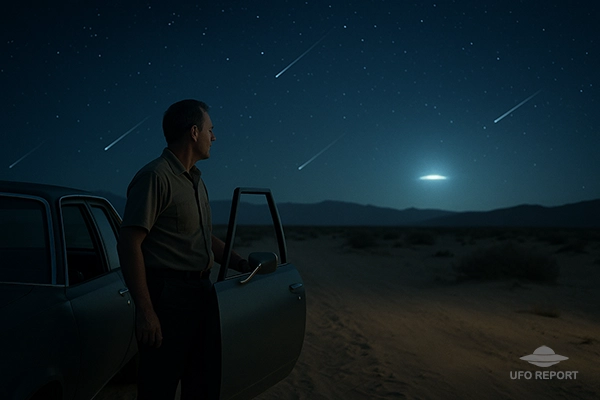
It was August 13, 1971. Sergeant Moody had finished his shift at Holloman Air Force Base — an installation long tied to America’s aerospace testing and missile development — and decided to watch a meteor shower from the edge of the Alamogordo desert. Just past 1:00 a.m., the night sky shimmered with streaks of falling stars, faint ripples of light stretching across the New Mexico horizon. The desert air was still, and the only sound was the hum of cicadas.
Then, Moody noticed something unusual. A glowing object — not a meteor — moved silently across the southern sky. It was metallic and disk-shaped, about 50 feet in diameter, emitting a pale bluish light that grew brighter as it descended. Unlike the meteors, it didn’t burn out or break apart. It maneuvered deliberately.
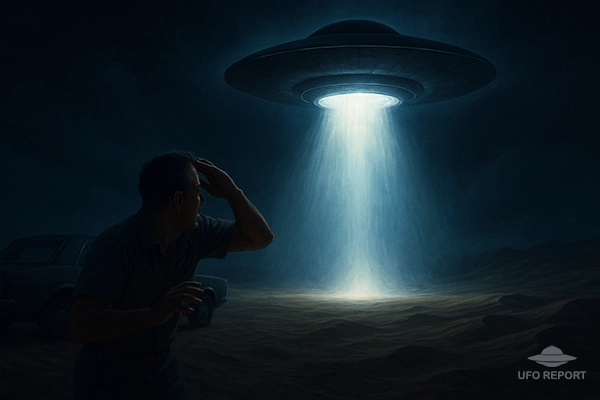
Intrigued, Moody climbed into his car and began to drive closer. The craft seemed to respond — slowing its descent and shifting direction as if aware of his pursuit. When it hovered about 300 feet above the ground, he stopped his car, rolled down the window, and listened. There was no sound — not even the faintest hum. As he stepped out, a blinding light burst from the craft.
Instantly, the air around him vibrated with heat. His limbs felt heavy, his muscles locking in place. The sensation spread across his body — paralysis mixed with a strange calm, as though his thoughts were being lifted from him. The bright light consumed everything, and the next thing Moody remembered was waking up in his car nearly an hour later, groggy and disoriented.
The Encounter in the Desert Sky
Over the next few days, Moody’s body ached. His skin tingled, his vision blurred, and his sense of time felt off. What disturbed him most, however, were the vivid fragments of memory that surfaced at night — images of tall, humanoid figures and metallic corridors bathed in blue light. He remembered a voice that wasn’t quite a voice — calm, direct, and echoing within his mind.
In later statements, Moody claimed that the beings communicated telepathically, assuring him he was in no danger. They told him they were peaceful observers, studying human behavior and physiology. “You will not remember everything now,” one said, “but when the time is right, you will understand.”
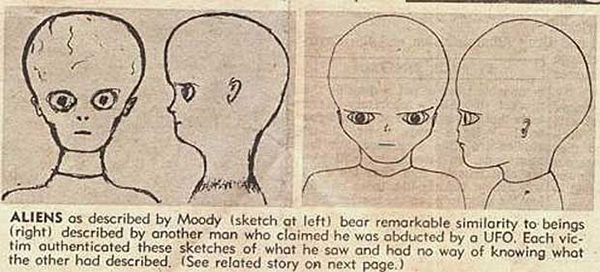
He recalled being shown around their craft — a smooth, windowless interior, glowing consoles, and a sense of total silence except for his own breathing. The beings, he said, were roughly five feet tall, with grayish skin and large eyes that seemed “ancient yet kind.” Then he remembered a piercing vibration, followed by blackness. When he awoke, the desert was empty again — stars glittering above, the meteor shower continuing as if nothing had happened.
Aftermath and Hypnotic Revelation
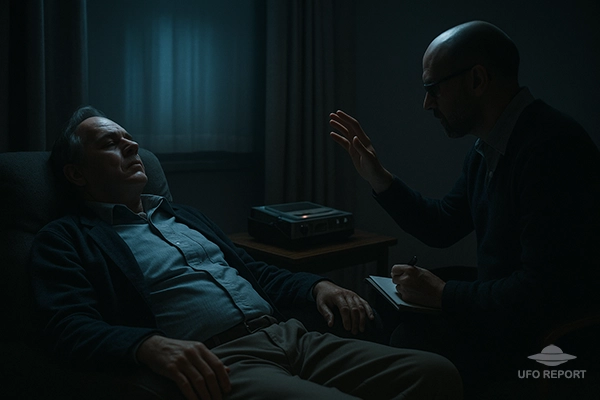
Haunted by insomnia and a lingering sense of unreality, Moody reported his experience to a superior officer but received little response. He then contacted a local UFO research group, who referred him to a psychologist trained in hypnotic regression — a technique gaining attention at the time due to cases like Betty and Barney Hill’s 1961 abduction account.
Under hypnosis, Moody described his missing hour in greater detail. He claimed that after his paralysis began, a beam of light lifted him aboard the craft. The beings examined him, taking skin and blood samples using painless instruments. They reportedly told him that human technology would one day allow peaceful interplanetary travel and that he had been chosen “to witness, not to fear.” When the session ended, Moody wept. He said he finally felt at peace, but also burdened with knowledge no one would believe.
His case quickly drew attention from UFO investigators in the U.S. and abroad. In 1973, Moody’s story was published in several UFO journals, eventually appearing in books like The Hynek UFO Report and UFOs and the National Security State. For believers, it became a cornerstone example of military-linked contact during the post-Project Blue Book era. For skeptics, it represented another in a long line of hypnosis-influenced experiences shaped by cultural fascination with alien contact.
Skepticism, Silence, and the Military Context
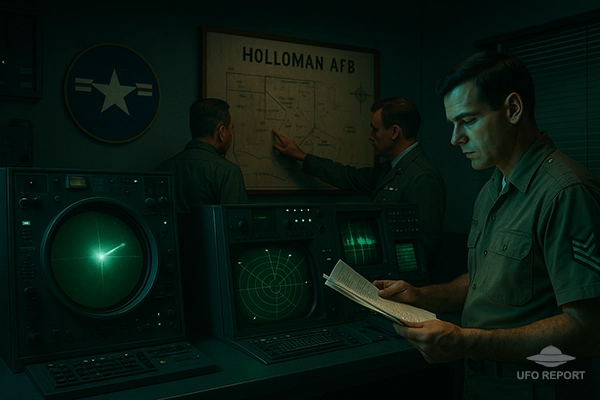
By the early 1970s, the U.S. Air Force had officially ended Project Blue Book, the decades-long investigation into UFOs, claiming that no sighting posed a threat to national security. Yet, encounters continued — often near military bases or missile ranges, including Holloman, White Sands, and Kirtland.
When asked about the incident, officials at Holloman Air Force Base denied any record of unusual radar activity or security alerts on the night in question. No reports of unauthorized airspace entries were filed. Moody’s file, if it existed, was never made public.
Skeptics pointed out inconsistencies in his story — changes in timeline, lack of physical evidence, and the possibility of hypnagogic hallucination (a waking dream state often triggered by fatigue). However, UFO researchers countered that Moody’s military training and technical expertise made him a credible observer. Unlike sensational tabloid cases, his tone remained measured and consistent for decades.
Adding intrigue, Holloman itself has long been a focal point for UFO lore. In 1974, filmmaker Robert Emenegger claimed that classified footage existed of a UFO landing at Holloman AFB in 1971 or 1972, allegedly involving Air Force officials meeting with extraterrestrial beings. Although the story has never been verified, its timing overlaps eerily with Moody’s own encounter — fueling speculation of a connection.
Legacy and Cultural Impact
The Holloman Incident became a staple of UFO literature through the 1970s and 1980s, often referenced alongside the Hill abduction and Travis Walton’s 1975 case. Moody himself maintained his account well into his later years, occasionally speaking at conferences and interviews.
His story also influenced the early development of abduction-research methodology, inspiring investigators like Budd Hopkins and Dr. David Jacobs to consider patterns across hypnotic testimonies — recurring details such as paralysis, telepathy, and examination aboard craft.
Sociologists studying the phenomenon note that Moody’s case arrived during a cultural shift — when UFOs were evolving from aerial mysteries into personal encounters. It reflected both the era’s optimism about space exploration and its growing unease with Cold War secrecy.
Between Reality and Belief
To this day, no physical evidence of the 1971 Holloman encounter has been found. No radar tracks, flight logs, or corroborating witnesses have emerged. Yet, the power of Moody’s story lies not in proof, but in persistence — the way it echoes through time, reshaping itself for each generation of believers and skeptics alike.
Perhaps it was a vivid hallucination born of exhaustion and isolation. Perhaps it was something far stranger — a fleeting crossing between human curiosity and an intelligence beyond our comprehension.
Standing under the New Mexico stars that night, Sgt. Charles Moody became, willingly or not, a participant in one of the most enduring unsolved encounters in modern history. Whether viewed as contact or conviction, myth or memory, his story endures as a reminder that the search for truth often begins in silence — and sometimes, it looks back at us from the dark.