

The mid-19th century was a time of transformation. The Industrial Revolution had changed England forever — steam engines thundered across the countryside, gas lamps lit the streets, and science was beginning to challenge superstition. Yet even in this age of logic and invention, the unexplained still had a powerful hold on the human mind.
In February 1855, a snowstorm blanketed the rolling hills of Devon. When morning came, the tranquil white landscape revealed something deeply unsettling — a continuous trail of hoof-shaped impressions pressed into the snow, stretching for miles across villages, fields, and rooftops. The tracks appeared overnight and seemed to follow no logical path. They crossed walls, traversed rivers, and even climbed onto thatched roofs, as though the maker of these prints obeyed no earthly limitations.
Before long, whispers turned to panic. The newspapers gave the phenomenon a name that would echo through history: The Devil’s Footprints.
The Night the Prints Appeared
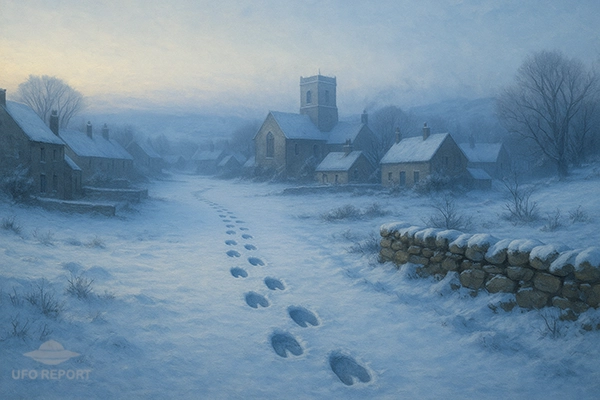
The events began on February 8th and 9th, 1855, when villagers from several Devon parishes — including Topsham, Dawlish, and Exmouth — awoke to find strange tracks etched across the frozen countryside. Each print was roughly four inches long and three inches wide, resembling the cloven hoof of a goat or small donkey. But what made them so bizarre was their formation: they appeared in a single, perfectly linear pattern, as though made by a creature walking on two legs.
The trail spanned more than 100 miles, sometimes vanishing briefly before reappearing on the far side of hedges, walls, and even wide rivers. Witnesses claimed the tracks continued across rooftops and through enclosed gardens, places no animal could have easily reached.
Local residents, already steeped in centuries of folklore about witches, demons, and spirits, quickly reached a chilling conclusion — the Devil himself had paid a visit to Devon.
A Country Gripped by Fear
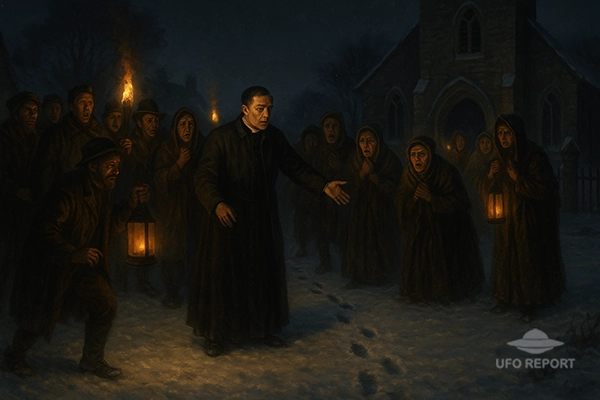
The story spread like wildfire. Church congregations whispered about omens and divine punishment, while skeptical townsfolk scoured the landscape in search of clues. In an age where science and faith often collided, this mysterious occurrence struck a nerve on both sides. Even local clergy were drawn into the debate, with some describing it as a test of faith or a warning to the sinful.
Letters flooded into newspapers across southern England. Reports described “a track of cloven hoofs extending miles upon miles,” “a phenomenon of the most extraordinary character,” and “an impression as if some unearthly being had walked the earth in the night.” The press coverage fueled public hysteria, and soon the event was known nationwide as The Great Devon Mystery.
Victorian England was fascinated by the intersection of the rational and the supernatural. Ghost stories filled parlors and penny dreadfuls, while spiritualism and séances grew in popularity. Against this backdrop, The Devil’s Footprints seemed both terrifying and tantalizing — a real-world riddle that neither priest nor scientist could explain.
The Search for Answers
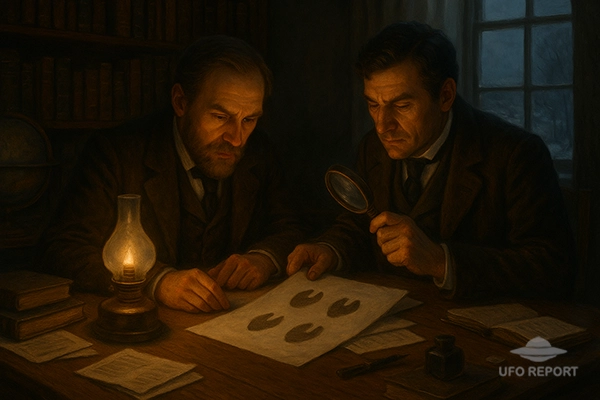
As with any great mystery, theories abounded — some rational, others extraordinary. Scholars, naturalists, and amateur sleuths all weighed in, attempting to make sense of the impossible.
The Hoax Hypothesis
The most common explanation offered was that the prints were a hoax — an elaborate prank designed to stir panic and amusement. Perhaps someone had strapped hooves or metal shapes to their shoes and walked deliberately through the snow. But the logistics make this theory difficult to accept. Covering over 100 miles of terrain overnight, through villages and open countryside, would have been nearly impossible without being seen. Moreover, the prints maintained perfect spacing and uniformity, something few pranksters could achieve by hand.
Natural Phenomena
Others turned to nature for answers. Some meteorologists suggested unusual atmospheric conditions could have created the illusion of tracks — snow thawing and refreezing into strange, repetitive shapes. Others speculated that falling debris, like hail or soot, might have melted the snow in hoof-like patterns. Yet none of these explanations adequately account for the long, continuous trail that traversed obstacles and varying terrain.
Misidentified Animal Tracks
Perhaps, some argued, the prints were made by animals — foxes, badgers, or even hopping rodents — whose tracks had distorted as the snow melted. There were even reports of escaped kangaroos from a private menagerie near Exmouth, though that explanation, while colorful, was quickly dismissed. No known animal in England leaves prints of that size, stride, and single-file formation.
The Paranormal Possibility
For others, the mystery was proof of something beyond the natural world. In the decades that followed, spiritualists and paranormal researchers would revisit the case, suggesting that The Devil’s Footprints were not of earthly origin. Some saw it as a demonic visitation, while modern theorists have speculated about atmospheric plasma, alien encounters, or interdimensional phenomena. While none of these claims can be proven, they illustrate humanity’s enduring need to find meaning in the unknown.
The Legacy of the Devil’s Footprints
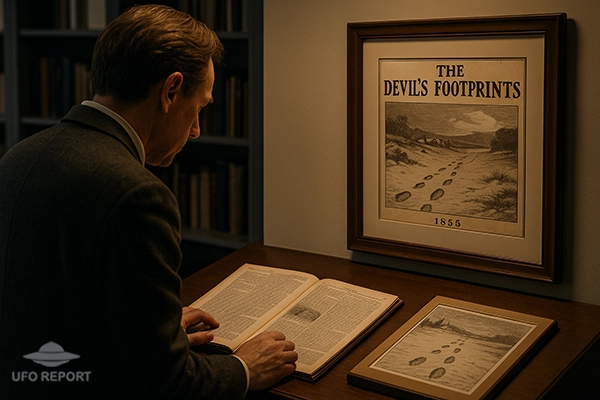
Over the years, the story of The Devil’s Footprints has become one of England’s most enduring legends. Retold in countless books, radio programs, and documentaries, it has inspired both serious investigation and imaginative storytelling alike. In parts of Devon, the tale remains alive in local folklore — whispers of a mysterious visitor said to return when the snow falls thick upon the countryside.
Today, the mystery survives not only in cultural memory but also within historical archives. Newspaper clippings, sketches, and handwritten letters from 1855 are carefully preserved in the Devon County Record Office, where researchers still examine them more than a century later. The correspondence of local clergymen and eyewitnesses describes a phenomenon both consistent and perplexing — tracks that seemed to appear from nowhere, cross every barrier, and disappear into the unknown.
For scholars and folklorists, The Devil’s Footprints stands as a remarkable case study in human psychology and belief. It illustrates how fear, faith, and fascination can converge to shape a legend that outlasts its witnesses. Whether viewed as an elaborate prank, a misunderstood natural event, or something beyond conventional explanation, the mystery endures as a cultural artifact bridging science and superstition.
What remains, long after the snow has melted, is the story’s quiet power — a reminder that even in an age of reason, mystery still finds a way to leave its mark.
A Symbol of the Unknown
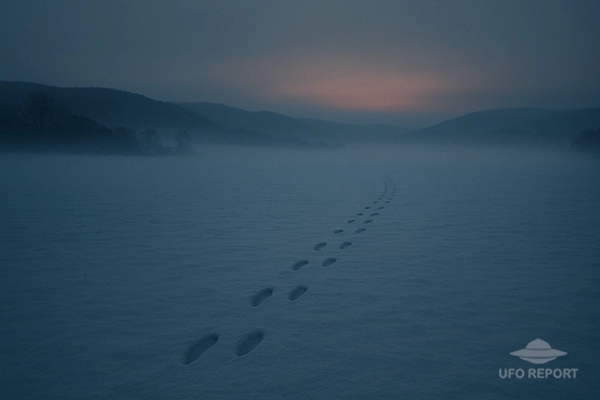
In the end, The Devil’s Footprints endure not because of what they were, but because of what they represent. They stand as a reminder of humanity’s perpetual curiosity — our instinct to search for meaning in mystery, even when logic fails to provide it.
The tracks that crossed Devon’s snowy fields were temporary, vanishing with the thaw. Yet the questions they raised remain frozen in time: Who — or what — could have left such perfect impressions across so vast a distance? Why did the phenomenon occur only once? And why, after nearly two centuries of investigation, does the answer still elude us?
In the fading light of that February dawn, something left its mark on the world — not only in the snow, but in the imagination of everyone who has ever wondered where the known ends and the mysterious begins.