

By the late 1970s, the era of official UFO investigation seemed to have ended. Project Blue Book had closed in 1969, and government interest in unidentified flying objects appeared to fade into history. Yet public fascination never waned. Reports of strange lights, vehicle interference, and unexplained aerial encounters continued to surface across the United States. Among them, one small-town case in Minnesota would stand out as both a mystery and a milestone.
In August 1979, a rural deputy sheriff encountered something on a lonely stretch of highway that changed his life. The event produced physical evidence, drew national attention, and remains one of the most credible unexplained incidents in modern UFO history. It came to be known simply as The Val Johnson Incident.
A Routine Patrol Turns Extraordinary
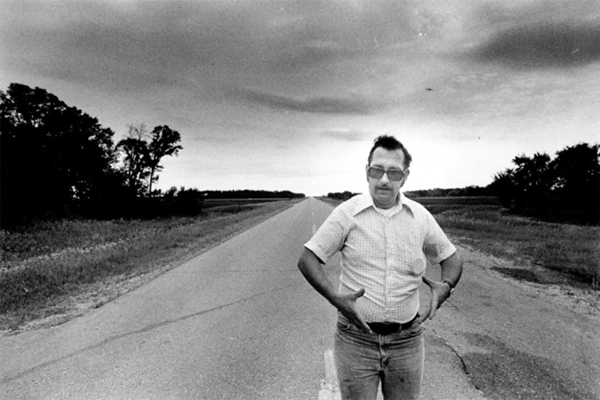
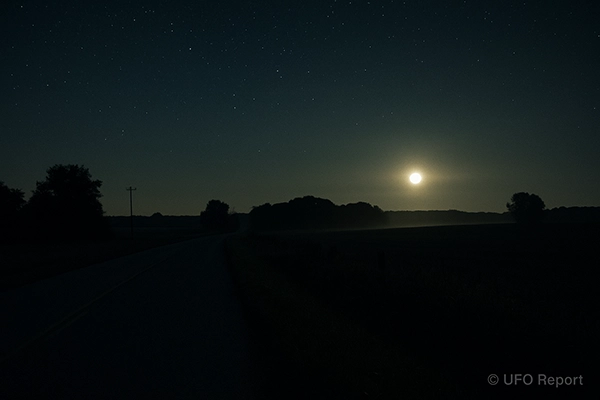
In the early hours of August 27, 1979, Deputy Sheriff Val Johnson of the Marshall County Sheriff’s Department was on patrol near Warren, Minnesota. The farmland around him was still and quiet under a moonless sky. His shift had been uneventful until, at around 1:40 a.m., he noticed a brilliant light hovering low over the horizon to the south.
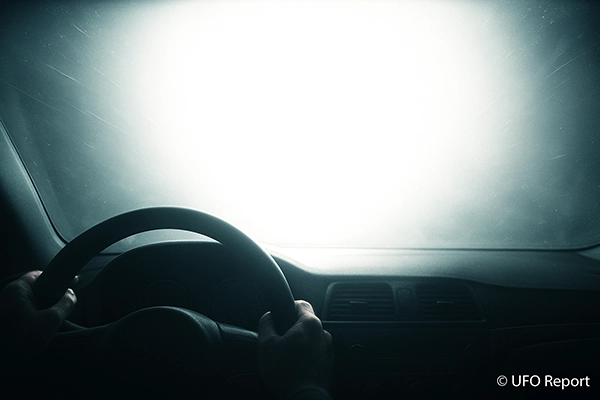
Believing it could be a small plane in distress or a landing light from a low-flying aircraft, Johnson turned his patrol car onto County Road 5 to investigate. The light appeared stationary at first, then began to move closer. It grew brighter and larger, until it filled his windshield with blinding intensity.
Before he could react, the light surged forward, engulfing his vehicle in an instant. Johnson heard a sharp sound like shattering glass and then lost consciousness. When he came to, he found his patrol car stopped sideways across the highway. His wristwatch and dashboard clock had both stopped for exactly fourteen minutes.
Johnson’s eyes burned painfully, his body ached, and he felt dazed but coherent. He grabbed his radio and called dispatch, speaking with the calm precision of a trained officer.
“Something just hit my car. I don’t know what it was.”
He had no memory of the moment of impact, only of the brilliant flash and sudden blackout.
Physical Evidence in Plain Sight
When backup officers arrived minutes later, they found a scene that defied easy explanation. The patrol car’s windshield was fractured in a circular pattern, as though struck by a focused wave of force rather than a single object. The hood bore a circular dent, smooth and centered, without any sharp indentation or paint transfer.
The left headlight was shattered, and the car’s radio antenna had been bent sharply at a 60-degree angle, halfway up its length. There were no skid marks, debris, or signs of collision. The surrounding road surface showed no disturbance.
Inside the car, the clock on the dashboard and Johnson’s wristwatch both read fourteen minutes slow compared to other timepieces. Mechanics who later examined the vehicle found no electrical malfunction that could explain the synchronized stoppage.
Johnson was taken to Warren Hospital for examination. Doctors found no head trauma or physical injuries, but both of his eyes showed mild burns consistent with flash exposure, the kind seen in welders or those who look directly into intense ultraviolet light.
For investigators, this was no ordinary traffic incident. Something powerful had interacted with both man and machine, leaving behind an array of puzzling physical clues.
The Investigation Begins
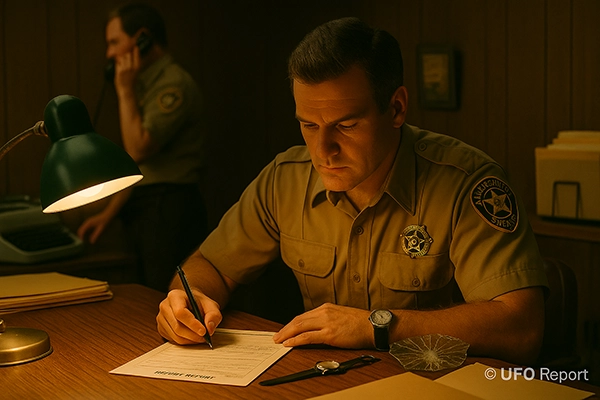
The Marshall County Sheriff’s Department immediately documented the case. Sheriff Dennis Brekke filed an official report that described Johnson as “alert but visibly shaken,” and the vehicle damage as “unlike any known collision.” The case quickly drew the attention of the media, as well as the Center for UFO Studies (CUFOS), founded by astronomer J. Allen Hynek, who had previously served as a consultant to the U.S. Air Force’s Project Blue Book.
Investigators from CUFOS and state agencies examined the car in detail. Metallurgical tests found no paint transfer, residue, or external impact consistent with another vehicle. The pattern of the shattered windshield appeared to radiate outward from an invisible center point, suggesting a sudden burst of energy or force.
Technicians from the General Services Administration examined the car’s internal components and confirmed the timepieces had indeed stopped for a synchronized fourteen minutes before resuming normal operation. Electrical systems showed no signs of power surge or battery interruption.
The incident also caught the interest of the Federal Aviation Administration, which reviewed flight logs and radar records for the night of August 27. No aircraft were reported or detected within 50 miles of the site at the time of the encounter.
Through every test and inquiry, the physical evidence remained consistent with Johnson’s account — a sudden, intense encounter with an unidentified source of light and force.
Theories, Speculation, and Scientific Debate
As the story spread across Minnesota and beyond, so did speculation. Some suggested that Johnson’s vehicle might have struck a small aircraft or drone. Yet no wreckage, paint, or mechanical fragments were ever found. Others proposed that the event was a hoax, though no motive, benefit, or prior deception could be established. Johnson himself avoided publicity and returned to duty within days, declining most interviews.
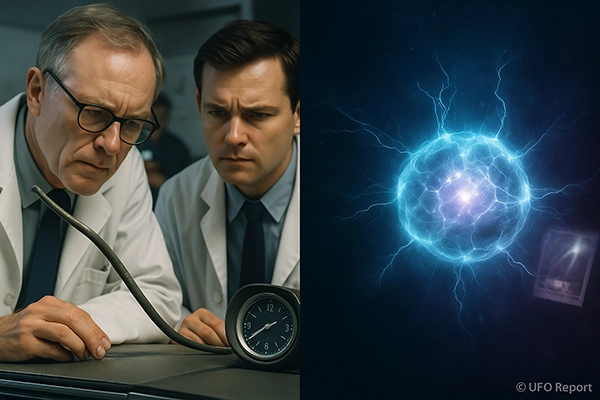
More serious investigators proposed natural explanations. A few scientists theorized that Johnson may have encountered ball lightning, a rare form of atmospheric plasma known to produce glowing spheres of light that move erratically and emit intense energy. However, this theory struggled to explain the physical car damage and simultaneous clock stoppage.
Another theory pointed to the possibility of an experimental military device being tested in the area — perhaps a high-intensity radar beam or low-altitude drone — though the U.S. Air Force denied any operations near Warren that night.
For UFO researchers, the event fit the criteria of a Close Encounter of the Second Kind, where an unidentified aerial phenomenon interacts physically with a person or object. The details — the flash, the electromagnetic interference, the mechanical deformation — mirrored patterns reported in other vehicle-interference cases worldwide during the 1970s.
To this day, no theory, natural or human-made, fully accounts for all the physical and temporal effects observed that night.
The Car That Wouldn’t Stop Telling Its Story
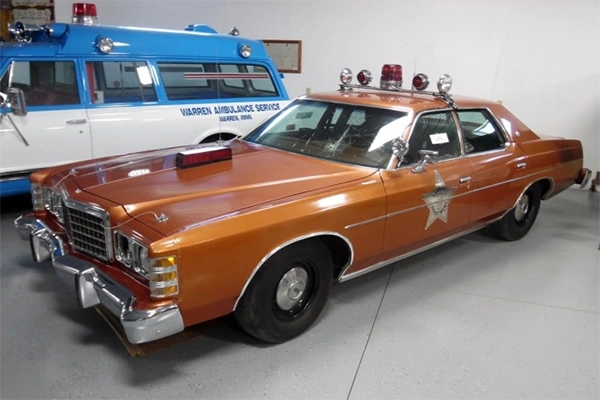
The patrol car at the center of the Val Johnson Incident became an artifact of the unexplained. Preserved by the Marshall County Historical Society Museum in Warren, it remains on public display, untouched since 1979. Visitors can still see the circular dent on the hood, the cracked windshield, and the antenna frozen in its unnatural bend.
For locals, it has become known simply as “The UFO Car.” Students, tourists, and skeptics alike come to inspect it, looking for ordinary answers to extraordinary damage. Yet the vehicle continues to resist explanation.
In 1980, J. Allen Hynek himself reviewed the case and noted that it represented one of the few UFO encounters backed by measurable physical evidence. Later analyses by engineers and television programs such as Unsolved Mysteries and UFO Hunters would reaffirm that, while the data is limited, the evidence supports Johnson’s claim of a brief but intense encounter with an unknown force.
Johnson’s own reflections remained modest and consistent over the years. He never claimed to have seen an alien craft, nor did he profit from the event. He described it simply as an experience with something beyond his understanding.
“It was real,” he once said, “but I don’t know what it was.”
Rediscovery and Modern Reexamination
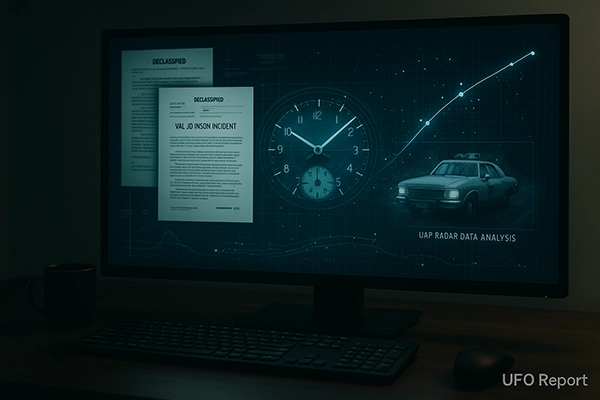
In recent years, renewed public and scientific interest in Unidentified Aerial Phenomena (UAPs) has brought cases like Val Johnson’s back into focus. Declassified government reports and new investigative frameworks have created opportunities to revisit older cases through modern analysis.
Contemporary researchers have compared the 1979 Minnesota case to more recent incidents involving military pilots who described similar effects — blinding light, instrument interference, and sudden acceleration beyond known aerodynamics. The parallels suggest that Val Johnson may have encountered an early manifestation of the same phenomenon now under study by the U.S. Department of Defense.
Documentary filmmakers and historians have reexamined the preserved patrol car using 3D scanning and spectral analysis. The results remain inconclusive, but they highlight one undeniable fact: the damage does not align with any known collision or environmental cause.
As modern technology advances, the Val Johnson case stands as an early, well-documented example of a UAP interaction involving both mechanical and physiological effects — the very kind of evidence that current scientific programs seek to analyze.
Legacy and Reflection
More than four decades later, the Val Johnson Incident endures as one of the most credible and haunting mysteries in American UFO history. It blends the professionalism of law enforcement with the strangeness of the unknown, producing a story that has resisted skepticism for generations.
For those who visit the Marshall County Museum, the sight of the weathered patrol car carries a quiet power. It is a reminder that the extraordinary often hides in the most ordinary places — a dark Minnesota highway, a deputy’s steady voice over the radio, a shattered windshield reflecting a light that no one has ever explained.
The case has become part of UFO culture’s living history, referenced in research archives, documentaries, and academic discussions about the nature of unidentified aerial phenomena. It has inspired countless debates and stands as a model for how serious investigation can coexist with open-minded curiosity.
Whether the light Val Johnson encountered came from a natural plasma event, a secret experiment, or something beyond the limits of human knowledge, the mystery remains. The evidence, the testimony, and the man himself continue to remind us that not every story has an ending — some are simply moments of contact between reality and the unknown.