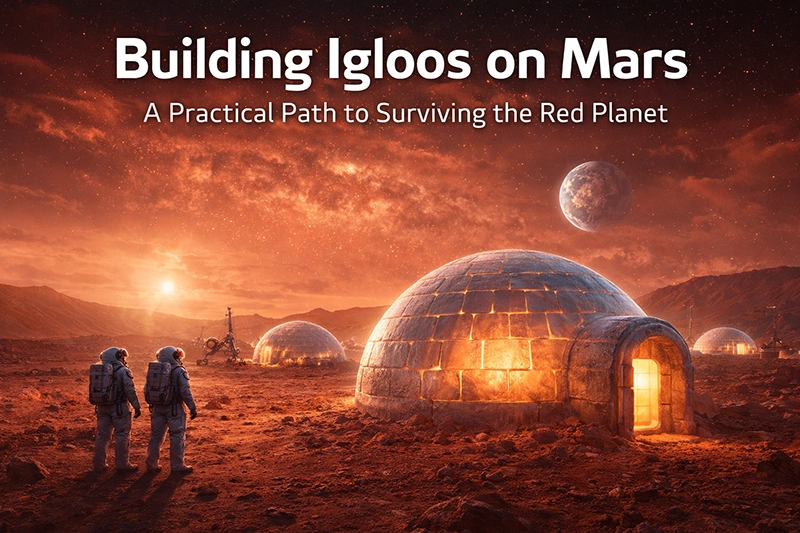
The idea of building igloos on Mars may sound unconventional, but it is rooted in real science and practical engineering. As plans for human missions to Mars move closer to reality, one of the biggest challenges is creating shelters that can protect astronauts from extreme cold, radiation, and a hostile environment. Interestingly, the same principles that make igloos effective in Earth’s polar regions could help solve these problems on Mars.
By combining ancient building concepts with modern technology, ice-based habitats could become one of the most efficient and sustainable ways for humans to live on the Red Planet.
Why Mars Requires a Different Approach to Housing
Mars is one of the harshest environments humans have ever attempted to inhabit. Average temperatures sit around -80°F, and they can drop even lower depending on location and time of year. The planet’s atmosphere is extremely thin, providing almost no protection from radiation or micrometeorites. On top of that, massive dust storms can cover the entire planet and last for weeks.
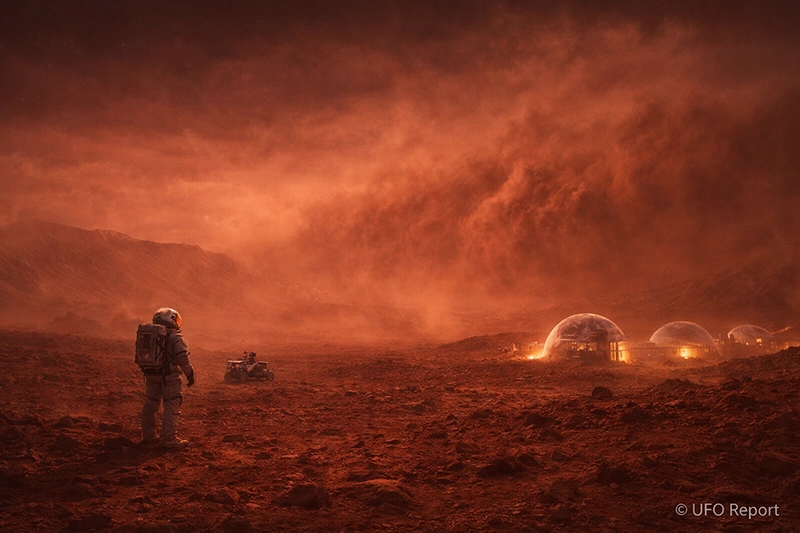
Unlike Earth, Mars lacks a strong magnetic field, meaning harmful cosmic radiation constantly reaches the surface. Any long-term habitat must provide both thermal insulation and radiation shielding. Transporting traditional building materials from Earth is not practical due to cost and weight limitations, so future habitats will need to rely heavily on local resources.
This is where ice-based structures, inspired by igloos, become a compelling solution.
The Science Behind Igloos
Igloos are effective because of how snow traps air within its structure. This trapped air acts as insulation, significantly slowing heat loss and allowing the inside of an igloo to remain much warmer than the outside environment.

On Mars, water ice can serve a similar purpose. Ice can act as both an insulator and a protective barrier. Its structure can reduce heat transfer, helping maintain stable interior temperatures, while also shielding inhabitants from radiation.
The dome shape of an igloo is equally important. Domes distribute stress evenly, making them strong and stable under pressure. This design is especially useful on Mars, where habitats must handle internal pressurization while withstanding external environmental stress.
How Igloos Could Be Built on Mars
Building igloos on Mars would rely heavily on automation and advanced construction techniques. Instead of manual labor, robotic systems would be used to extract water ice from beneath the Martian surface, where large deposits are believed to exist. This ice could then be processed, melted, and reshaped into usable строитель materials for habitat construction.
One of the most promising approaches is 3D printing. Autonomous machines could deposit layers of ice or ice-based composites to form strong, dome-shaped structures. This method allows for precision, efficiency, and reduced risk to human crews during early mission phases. Construction could begin before astronauts even arrive, ensuring shelters are ready upon landing.
These ice domes would serve as the outer protective shell, designed to provide insulation and radiation shielding while taking advantage of locally available resources.
Inflatable Habitats Inside Ice Igloos
A key advancement in Mars habitat design involves combining ice igloos with inflatable structures, a concept actively explored by NASA. Instead of relying solely on rigid interiors, astronauts could live inside expandable habitats that are transported in compact form and deployed once on Mars.
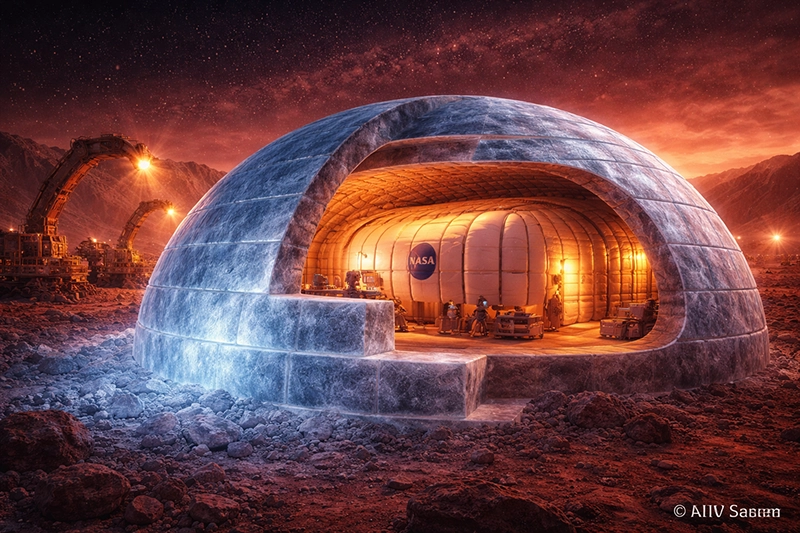
Inflatable habitats, like the Bigelow Expandable Activity Module tested aboard the International Space Station, demonstrate how lightweight structures can expand into large, livable spaces. These modules are made of multiple durable layers that provide insulation, pressure retention, and protection against impacts.
In a Mars igloo system, the inflatable habitat would sit inside the ice dome. The outer ice layer would act as a natural shield against radiation, extreme temperatures, and environmental hazards, while the inner inflatable module would maintain air pressure and provide a comfortable living environment.
This hybrid design offers the best of both worlds: rapid deployment and scalability from inflatable technology, combined with the strength and protection of ice-based construction. It is one of the most practical and promising approaches for establishing sustainable human habitats on Mars.
Advantages of Ice-Based Habitats
Ice-based habitats offer several major advantages for Mars colonization. First, they make use of local resources, reducing the need to transport heavy materials from Earth. This significantly lowers mission costs and increases scalability.
Second, ice provides natural radiation shielding, which is one of the most critical requirements for long-term survival on Mars. Third, its insulating properties help maintain stable temperatures, reducing the amount of energy needed for heating systems.
There are also potential psychological benefits. Semi-transparent ice domes could allow astronauts to see the Martian landscape and sky, helping reduce feelings of isolation and confinement over long missions.
Challenges and Limitations
Despite their potential, building igloos on Mars comes with challenges. Ice can become brittle and crack under stress, especially with temperature fluctuations. Engineers would need to design structures that can handle these conditions over long periods.
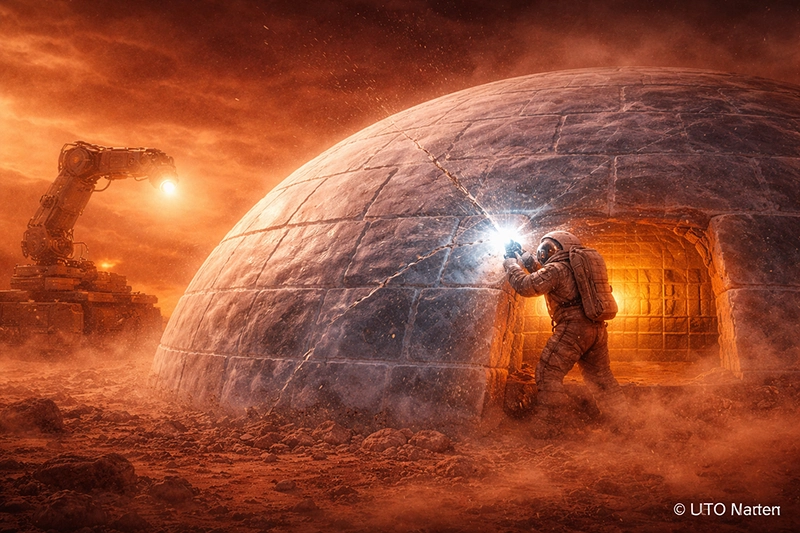
Another concern is sublimation. In Mars’ thin atmosphere, ice can slowly turn directly into vapor. Preventing this would require protective coatings or maintaining controlled pressure conditions around the structure.
Dust is also a major issue. Martian dust could accumulate on the surface of the habitat, reducing light transmission and potentially affecting structural integrity. Regular maintenance systems would be necessary to keep habitats functioning properly.
Finally, the success of these structures depends on reliable robotics, energy systems, and life-support technologies, all of which are still being developed and tested.
A Step Toward Living on Mars
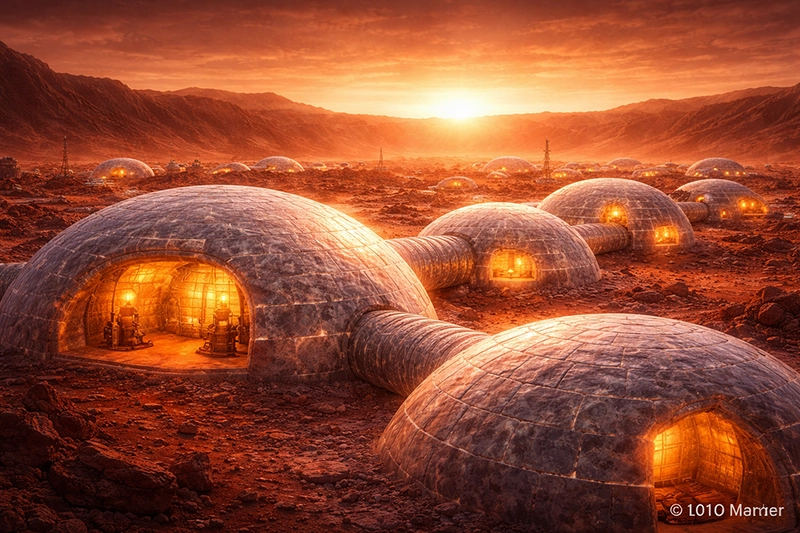
The concept of igloos on Mars demonstrates how simple, proven ideas can be adapted for entirely new environments. By combining the natural advantages of ice with modern engineering and automation, scientists are developing solutions that could make long-term human life on Mars possible.
As exploration efforts continue, ice-based habitats may become one of the first viable building methods for Martian settlements. What began as a survival technique in Earth’s coldest regions could ultimately help humanity expand beyond our home planet.
In the end, building on Mars may not require reinventing shelter from scratch, it may simply require rethinking it.