

In the early morning hours of July 24, 1948, a passenger flight crossing the southern skies of the United States became the stage for one of the most mysterious and influential UFO sightings in American history. The Chiles-Whitted UFO Encounter, as it came to be known, was not a fleeting light in the sky seen by a lone observer. It was a direct, close-range encounter witnessed by two professional airline pilots and partially corroborated by a passenger aboard an Eastern Air Lines DC-3.
At a time when the United States was just beginning to come to terms with the idea of unidentified flying objects, this case captured public and military attention alike. The sighting occurred barely a year after Kenneth Arnold’s famous encounter over Mount Rainier in 1947, which introduced the term “flying saucer” to the public. Yet unlike Arnold’s distant formation of discs, the Chiles-Whitted event unfolded face-to-face in the night sky, forcing even seasoned aviators to question what they saw.
This encounter did more than add another chapter to UFO folklore. It influenced the creation of official government investigations, challenged scientific assumptions, and helped define the image of cigar-shaped UFOs that would reappear in hundreds of reports to follow.
A Flight Into the Unknown
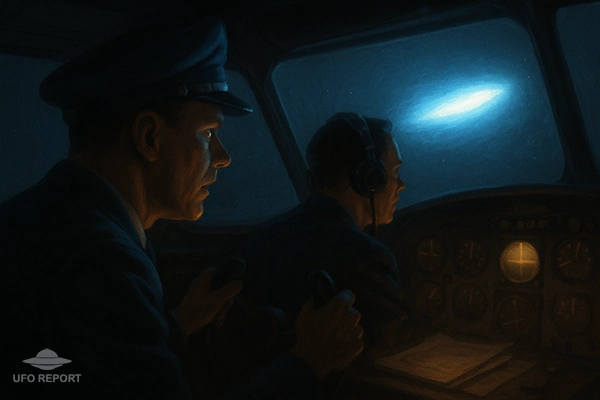
It was 2:45 a.m. when Captain Clarence S. Chiles and Co-pilot John B. Whitted, both veterans of World War II and respected commercial pilots, were guiding Eastern Air Lines Flight 576 from Houston to Atlanta. The weather was calm, the skies clear, and their Douglas DC-3 passenger plane cruised at approximately 5,000 feet near Montgomery, Alabama.
As they flew eastward, Chiles noticed a brilliant light ahead of them in the distance. At first, he assumed it was the light of an approaching jet or another aircraft coming toward their altitude. But within seconds, the light intensified and took on a strange, elongated shape. Both men soon realized they were not watching a conventional plane.
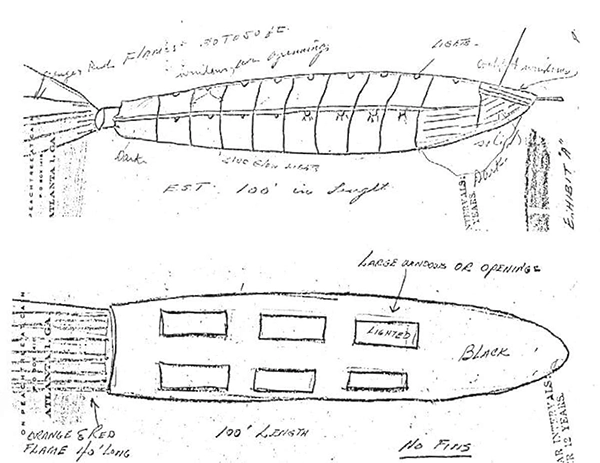
According to their official statements, a cigar-shaped object appeared to be heading directly toward their DC-3, glowing with an intense bluish-white light. Along its side, the pilots could see two rows of illuminated windows, and a fiery orange-red exhaust seemed to flare from the rear. The object sped toward them at astonishing speed, then suddenly pulled upward in front of the cockpit and shot into the clouds above with a blinding flash.
The entire encounter lasted only about ten seconds, yet both pilots described the event with remarkable clarity. Chiles later wrote in his report, “It was like a wingless aircraft, shaped like a torpedo. There were no protruding parts, no wings, no tail — just a smooth body and a fiery trail.” Whitted independently confirmed the same details.
A passenger named C. L. McKelvie, seated near a window, also reported seeing a bright flash of light at the same moment, though he did not witness the full object. His testimony nonetheless supported that something extraordinary had indeed occurred outside the aircraft.
Official Inquiry: Project Sign Takes Notice
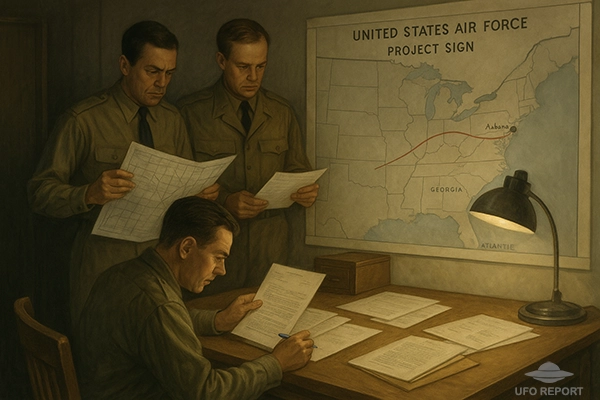
At the time of the sighting, the U.S. Air Force had only recently established Project Sign, its first official program dedicated to studying the UFO phenomenon. The Chiles-Whitted report arrived at the height of mounting concern that strange objects in the sky could represent a national security issue.
Air Force investigators interviewed both pilots extensively and reviewed their flight data and weather conditions. The consistency of their accounts, coupled with their aviation expertise, made it difficult to dismiss. The men were not prone to exaggeration, nor did they have any apparent motive for fabrication. They were respected professionals whose careers depended on precision and credibility.
Initially, Project Sign’s analysts concluded that the sighting was “unidentified” — one of the earliest cases in which trained observers reported a structured, apparently metallic object performing aerial maneuvers beyond known technology. The sighting’s proximity, lighting detail, and multiple witnesses placed it among the most compelling UFO cases of its time.
But as reports multiplied across the country, the tone within the Air Force began to shift. Skepticism grew. Some officials feared that endorsing unexplained phenomena might cause public panic or undermine confidence in air defense capabilities. By the end of 1948, Project Sign’s cautious openness to the idea of extraterrestrial visitation gave way to the more dismissive attitude that would define its successor, Project Grudge.
The Meteor Theory and Its Critics
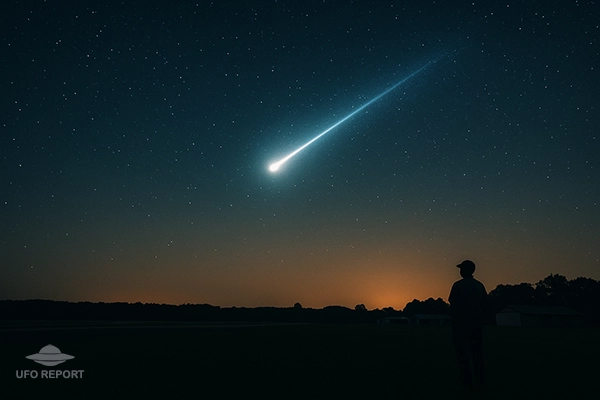
When the Chiles-Whitted encounter could not be easily classified, investigators turned to more conventional explanations. One theory quickly gained traction: the pilots had mistaken a bright meteor or bolide for a structured craft. According to this idea, a large meteor entering the atmosphere might appear to streak horizontally before disintegrating in a flash — consistent with some aspects of their description.
However, several key details did not fit. Meteors do not display rows of illuminated windows, nor do they make controlled maneuvers or sudden climbs. The object’s apparent level flight path and abrupt vertical ascent contradicted the ballistic trajectory of any natural meteor. Furthermore, both pilots insisted the object had a solid structure, not a diffuse glow.
Even Air Force analysts were divided. The official report ultimately categorized the case as a probable meteor but acknowledged unresolved inconsistencies. Years later, researchers reviewing declassified Project Sign documents discovered that early drafts of the analysis had leaned toward the possibility of an interplanetary origin — a conclusion that was reportedly removed before the final report was released.
This quiet alteration reflected the growing political pressure to downplay UFO sightings. While the Air Force publicly labeled it a meteor, many within Project Sign and later Project Blue Book privately admitted that the Chiles-Whitted case defied full explanation.
Echoes in the Sky: Other Witnesses and Correlations
Within hours of the Chiles-Whitted encounter, another report surfaced that seemed to corroborate their story. In Robins Air Force Base, Georgia, a ground observer reported seeing a bright, cigar-shaped object streak across the night sky heading east — precisely the direction of the pilots’ sighting. The timing and description matched closely enough to suggest both parties may have seen the same object from different angles.
This secondary account strengthened the case that something genuine, not illusory, had been in the sky that night. It also marked one of the earliest instances where a multi-location UFO sighting was recorded and cross-referenced, a method that would become standard practice in later investigations.
The Chiles-Whitted sighting also coincided with a pattern of similar reports during the summer of 1948, many describing cylindrical or cigar-shaped craft rather than the disc-like objects of earlier fame. These sightings helped establish the “elongated craft” archetype that would recur throughout the 1950s and 1960s, often associated with alleged “mothership” appearances or metallic aerial vehicles lacking visible wings or propulsion systems.
Scientific Analysis and the Human Factor
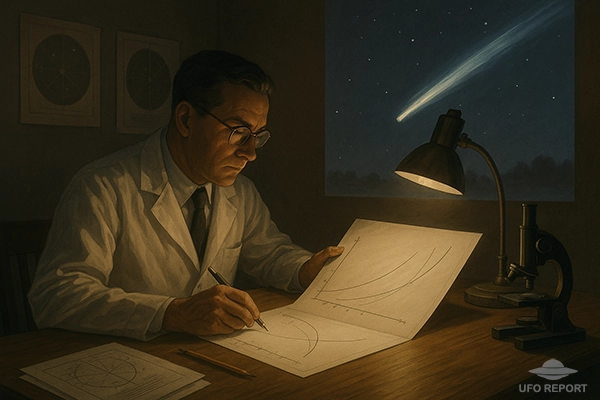
Over the decades, the Chiles-Whitted encounter has been examined through various scientific lenses — optical illusion, misperception, atmospheric refraction, and psychological stress among them. Yet none have provided a fully satisfactory answer.
Astronomers who reviewed the meteor hypothesis pointed out that while bright bolides can create temporary illusions of structure, it is unlikely that two pilots with thousands of flight hours would mistake one for a nearby object with defined windows. Moreover, the reported maneuver — an abrupt climb into the clouds — remains inconsistent with any known natural or artificial phenomenon from that era.
Some psychologists have suggested that the pilots’ war experience might have influenced their perception, causing them to interpret an ambiguous visual event as something structured and technological. However, this theory falters under scrutiny since both men described identical details independently, and their statements remained consistent under investigation.
In the 1960s, scientists from the University of Colorado UFO Project, led by physicist Edward Condon, reanalyzed the case. Their findings concluded that while a meteor remained a plausible explanation, the pilots’ descriptions contained details “not typical of meteoric behavior.” The Condon Committee therefore classified the Chiles-Whitted incident as “unresolved.”
Legacy of America’s First Airborne Mystery

The Chiles-Whitted encounter occupies a pivotal place in UFO history. It was the first major UFO case involving commercial airline pilots, establishing a precedent for future aviation-related encounters. It also highlighted the growing tension between credible eyewitness testimony and institutional reluctance to accept extraordinary claims.
The event influenced not only Project Sign but also the transition to Project Grudge and later Project Blue Book, shaping how the U.S. Air Force approached unidentified aerial phenomena for the next two decades. It underscored the difficulty of balancing public transparency with military caution during the Cold War, when unexplained aerial sightings were as likely to be foreign craft as they were cosmic mysteries.
For historians and ufologists alike, the Chiles-Whitted case remains a cornerstone — a moment when the unknown crossed paths with the professional precision of flight crews trained to recognize every type of aircraft in the sky.
Today, the incident endures as both a scientific puzzle and a cultural milestone. Its imagery — a glowing, windowed object cutting through the night sky — has inspired countless depictions of classic “flying cigars” in media, literature, and witness reports. Yet beyond the myth, the case’s core remains unbroken: two skilled aviators saw something tangible, structured, and beyond explanation.
As modern radar systems and satellite tracking grow ever more sophisticated, the Chiles-Whitted sighting reminds us that even the most advanced eyes in the sky may not see everything clearly. The mystery lingers not because it resists belief, but because it resists certainty. And for that reason, it stands as one of the most enduring encounters of the early UFO era — America’s first airborne mystery, still gliding silently through the archives of history.