

Maritime disappearances in regions known for anomalous sonar readings
Beneath the waves lies a silent world of tragedy and memory — the resting places of ships swallowed by the sea. Yet even in this realm of rust and coral, some vessels defy expectations. They don’t just lie forgotten — they disappear.
In recent decades, oceanographers and sonar technicians have stumbled upon a baffling phenomenon: shipwrecks that simply vanish. These wrecks, once carefully mapped, later fail to appear on sonar. Some reappear miles away. Others are erased completely, as though the sea itself rewrote its own history.
From the North Atlantic’s stormy depths to the Mariana Trench, from the frozen waters of Lake Superior to the methane plains off Japan, these strange gaps have given rise to the legend of the Ghost Fleets of the Deep — a series of maritime vanishings where human reason gives way to mystery.
The Disappearing Wrecks of the North Atlantic
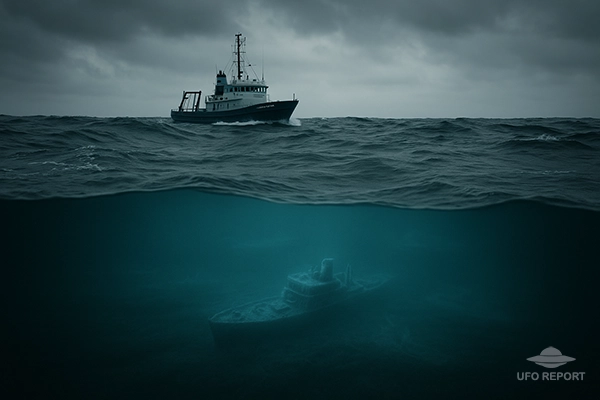
In 2018, a joint expedition between NOAA and the Royal Navy revisited a cluster of World War II shipwrecks near Ireland’s rugged northwest coast — among them the HMS Laurentic and SS Empire Heritage. The goal was to conduct ecological assessments of the aging wrecks. But when sonar imaging began, the team noticed something wrong. Several smaller vessels — previously logged in 2004 with exact coordinates — were gone.
The seabed where they once lay was smooth and unbroken, as though the ocean floor had swallowed them whole. Divers deployed submersibles, but there was nothing — no debris, no trace of disturbance, not even a metallic signal. Some scientists blamed sediment drift or underwater landslides, yet the missing wrecks had been located in geologically stable zones. Others pointed to trawler damage, though the sites were far too deep for commercial nets.
Then came something stranger. Hydrophones in the same area recorded low-frequency metallic tones, like the echo of steel resonating somewhere in the distance. It was almost as if the ships hadn’t disintegrated — but moved. Researchers now refer to the region as the Phantom Fleet of Donegal Deep — a stretch of ocean where sonar data refuses to stay consistent.
Pacific Shadows — Submarines That Slipped Away
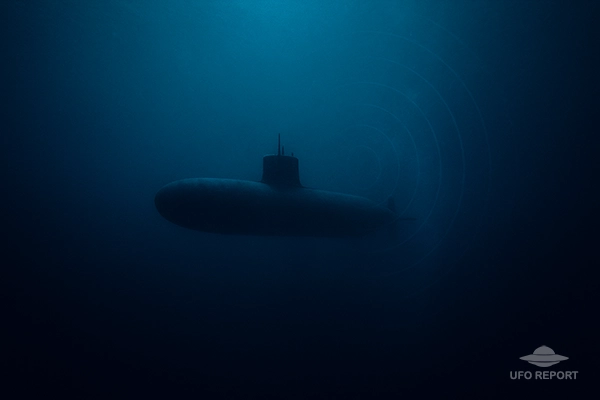
Thousands of miles to the east, the Pacific Ocean holds another puzzle. During the 1990s, deep-sea expeditions sought to locate several lost submarines from World War II — among them the USS Pickerel, believed to rest near the Mariana Trench. Initial scans in 1998 revealed what appeared to be a large metallic structure resting at nearly 4,700 meters. A follow-up mission a year later found… nothing. The wreck was gone.
Subsequent passes detected faint geometric echoes several kilometers away, too orderly to be natural but too distorted to confirm. Commercial trawlers operating near Guam reported sonar interference zones — regions where pings vanished entirely, as if absorbed by an unseen medium.
Oceanographers attributed the anomalies to extreme thermal layering or salinity gradients bending sonar waves. But retired sonar operators familiar with Cold War submarine monitoring offered another theory — that transient objects, perhaps metallic, were distorting sonar returns by passing near or over wreck sites. Whatever the cause, one pattern stood out: the deeper the trench, the stranger the readings.
Lake Superior’s Restless Graveyard
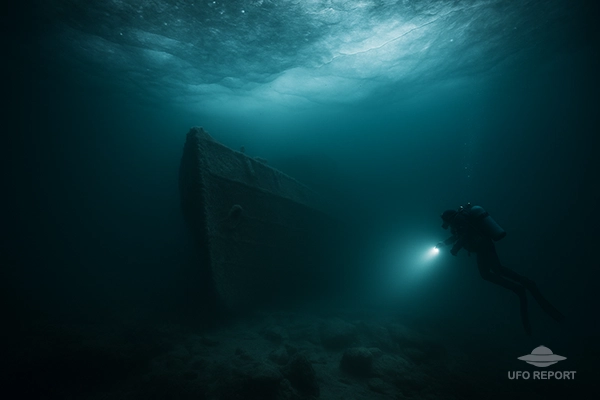
The world’s largest freshwater lake has always been a keeper of secrets. Lake Superior, where over 350 vessels are known to have sunk, has long been called “the Inland Sea.” But in recent years, sonar teams have noted something inexplicable: wrecks that shift or vanish entirely.
Between 2015 and 2021, the Great Lakes Shipwreck Historical Society documented three separate cases where previously mapped wrecks no longer appeared in their proper locations. One was the SS Bannockburn — the so-called “Flying Dutchman of the Great Lakes.” Rediscovered in 2006 after a century missing, it disappeared again from sonar scans less than two decades later.
Magnetic field readings in the area fluctuate dramatically, suggesting localized geomagnetic distortions could be to blame. However, several divers have described seeing distant blue-white lights below the thermocline — movements that don’t correspond to known submersibles or marine life. As one diver put it, “Sometimes you feel like something’s still down there — watching, moving — but not a ship, not a creature. Just… presence.”
Anomalous Zones and Oceanic Blind Spots
Across the globe, a curious pattern emerges. The majority of these “ghost fleet” disappearances occur near areas of geomagnetic variation, methane hydrate activity, or deep thermocline layering — environments known to distort sound and light.
Sonar engineers often refer to these as acoustic blind spots — pockets where sonar waves scatter unpredictably, producing phantom readings. But anomalies go beyond instrument error. In several cases, wrecks have been physically relocated or missing from subsequent dives, despite being embedded in sediment layers.
In parts of the Bermuda Triangle, the Puerto Rico Trench, and the Sea of Japan, sonar operators have reported “mirage targets” — shapes that appear structured on first scan and vanish on the second. These echoes are so consistent that military researchers have assigned them designations like “Transient Acoustic Phenomena (TAP)” and “USO interference.”
It raises an eerie possibility: some of the ghost fleets may not be vanishing — they may be masked.
From Wrecks to Legends
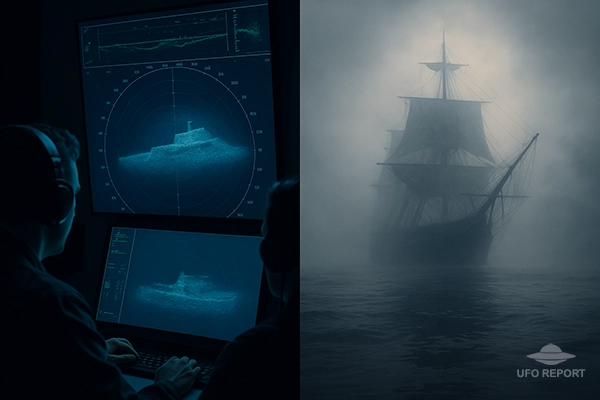
For centuries, sailors have told stories of ghost ships — spectral vessels glowing in fog, heralds of doom. In the digital age, we now have their technological equivalent: ghost sonar.
Oceanographers exploring methane vent fields in the Pacific have captured sonar footage of structured metallic shapes appearing briefly near gas plumes before vanishing. Some suggest these might be portions of dislodged wrecks or temporary mirages caused by light refraction. Others argue we may be observing unknown subaqueous phenomena — possibly the same kind of transmedium craft reported by naval pilots in recent years.
A declassified 2015 Russian Navy report even mentions “fast-moving submerged objects of non-terrestrial origin” interfering with wreck mapping in the Barents Sea — an echo of the 1982 Lake Baikal USO encounters. Skeptics insist all can be explained through physics: sonar distortion, magnetic anomalies, or shifting currents. But the coincidences — wrecks disappearing precisely where sonar returns falter — keep the mystery alive.
Legacy of the Lost Fleets
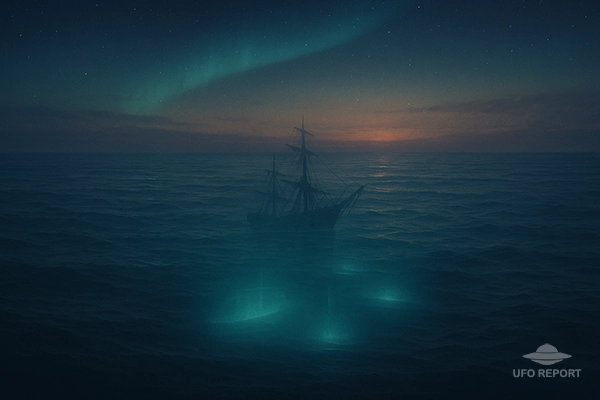
Modern mapping programs like Seabed 2030 have set an ambitious goal: to chart every corner of the ocean floor by the end of the decade. Yet for every new wreck discovered, another seems to fade from record. Whether buried by sediment, shifted by unseen forces, or hidden by anomalies we don’t yet understand, these vanishings remind us that even in an age of satellites, the ocean still guards its secrets.
To many researchers, the ghost fleets are more than maritime curiosities — they are symbols of our technological limits.
The deep doesn’t just consume steel and timber; it consumes certainty. As NOAA researcher Dr. Leah Morgan put it, “We expect the ocean to be a graveyard. But sometimes, it’s a magician. It makes the dead disappear.”
The ghost fleets of the deep remain one of the most haunting mysteries of the modern era — a reminder that even with sonar, satellites, and science, there are still places beneath the waves where history itself vanishes without a trace.