
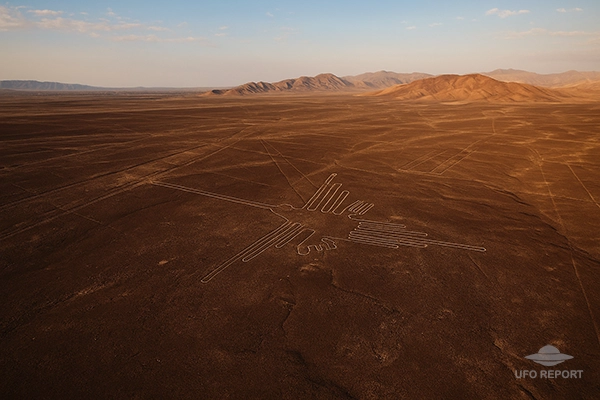
In the arid expanse of southern Peru, where the desert meets the foothills of the Andes, lies one of humanity’s most enduring mysteries — the Nazca Lines. Etched into the earth over 1,500 years ago, these enormous geoglyphs stretch across the barren plains like whispers meant for the heavens. From the ground, they appear as faint furrows in the soil. From the air, they reveal vast designs — animals, geometric shapes, and patterns so precise that their creators seem to have drawn with the hand of a surveyor and the vision of a god.
Carved by the Nazca civilization between 400 and 650 CE, these figures range from simple lines and trapezoids to intricate depictions of spiders, monkeys, condors, hummingbirds, and even a strange humanoid figure known as “the Astronaut.” The largest span over 1,200 feet, their scale so immense that they were invisible to those who walked among them. How, then, were they made — and for whom were they meant?
Earth and Air: How the Lines Were Made
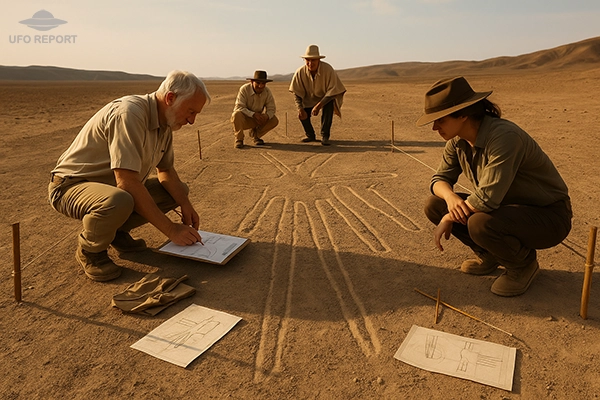
The technique behind the Nazca Lines is deceptively simple. By scraping away the reddish-brown top layer of desert gravel, the Nazca people exposed the pale earth beneath. The dry, windless climate preserved the lines remarkably well for centuries. Yet what astonishes scientists isn’t the method — it’s the execution. Many of the designs are drawn with perfect proportions and smooth curves, despite being impossible to view in full from the ground.
Some researchers believe that the Nazca used wooden stakes and ropes as surveying tools to scale their drawings upward, using basic geometry and mapping techniques. But the precision of their straight lines — running for miles across uneven terrain — suggests a level of planning and skill far beyond what might be expected from a pre-Incan culture without metal tools or flight.
Standing amid the lines, one feels the strange duality of the place: both intimate and cosmic, human yet divine. It’s as though the Nazca were not simply drawing on the desert — they were communicating through it.
A Landscape of Symbols
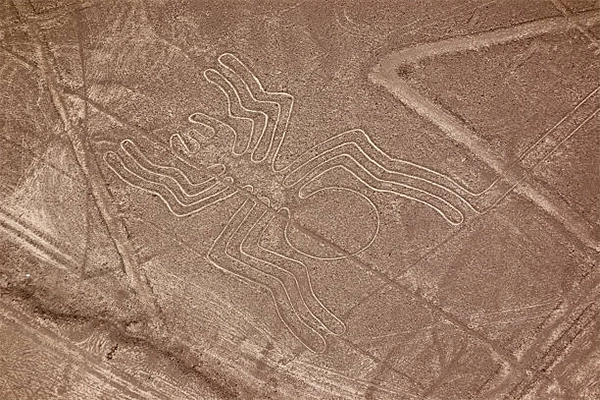
The shapes carved into the Nazca Desert are not random. Each carries meaning, myth, or ritual — their alignment forming what some scholars call a “sacred geography.” The animal figures may represent constellations, fertility symbols, or guardian spirits. The monkey’s spiral tail and the spider’s symmetry may have mirrored celestial patterns or invoked rain in a desert where water was life’s rarest gift.
Others see the lines themselves — long, straight paths that converge at ceremonial centers — as ritual walkways used in processions. The Nazca may have walked these lines in devotion, tracing them as living prayers visible only to the gods above.
Archaeologist María Reiche, known as the “Lady of the Lines,” spent her life studying and preserving the site. She believed the designs formed a vast astronomical calendar, charting the movements of the sun, moon, and stars. Modern studies have confirmed that some lines align with solstices and horizon markers, suggesting that the Nazca’s worldview was both earthly and celestial — bound by cycles of time, nature, and divinity.
Messages to the Gods — or to the Sky?
If the lines were made to be seen from above, who was watching?
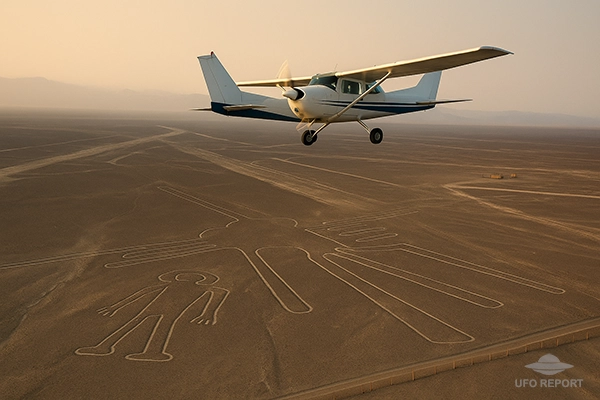
To modern minds, the Nazca Lines have become symbols of both wonder and speculation. Ancient astronaut theorists — including Erich von Däniken — famously proposed that the geoglyphs served as landing strips or beacons for extraterrestrial visitors. Others interpret the humanoid “Astronaut” figure as a representation of beings descending from the heavens.
While mainstream archaeology rejects these interpretations, their popularity speaks to something deeper: humanity’s instinct to look upward for answers. Whether the Nazca were addressing gods, stars, or something else entirely, the truth remains elusive — suspended between science and mythology.
Perhaps, as some researchers suggest, the lines weren’t meant to be “seen” at all, but to be experienced — walked, danced, and prayed upon, their meaning revealed through movement and ritual rather than sight.
Preservation Amid the Desert Winds
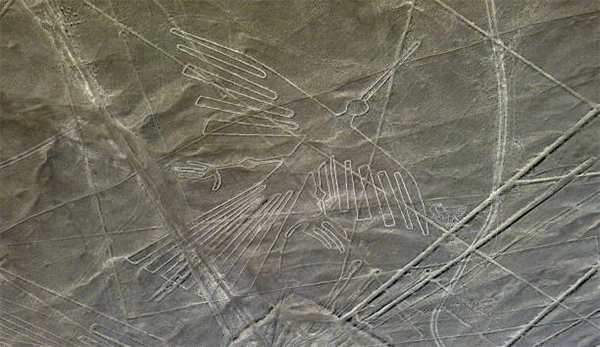
For centuries, the Nazca Lines lay undisturbed, protected by the desert’s aridity. But in recent decades, they have faced growing threats from human activity, mining, and climate change. Tire tracks, roadways, and even careless tourism have damaged portions of the delicate designs.
Peru has since declared the region a UNESCO World Heritage Site, with aerial monitoring, restricted access, and educational initiatives to preserve the lines. Drones now map their geometry from above — the same vantage point their creators might have imagined for divine observers millennia ago.
Standing at the desert’s edge at sunrise, when the wind is still and the light is gold, one can almost sense the intention behind these vast carvings. They are not simply drawings but acts of devotion — messages across time, written in earth, addressed to the sky.
Legacy of the Desert Messengers
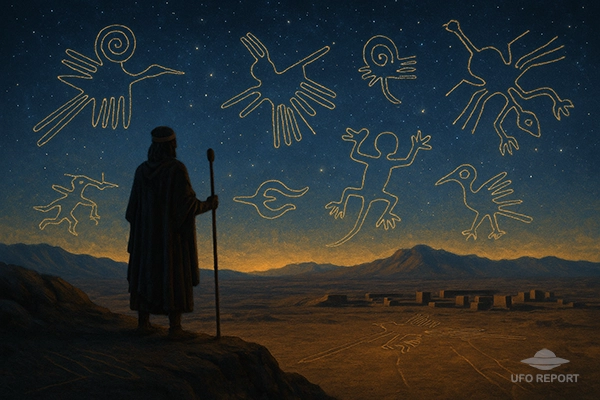
Today, the Nazca Lines continue to defy simple explanation. Were they a calendar, a ritual ground, or an offering to unseen gods? Or do they represent something even more profound — humanity’s first large-scale expression of its awareness of the cosmos?
Their mystery endures not because we lack evidence, but because their meaning transcends measurement. They remind us that early civilizations did not separate art, science, and faith — they wove them together into symbols meant to connect heaven and earth.
Whether traced by priests invoking rain or artists mapping the stars, the Nazca Lines stand as proof that ancient people were not just looking at the world around them — they were reaching beyond it.
Beneath the unbroken Peruvian sky, their message still stretches across the desert: a silent geometry of devotion, precision, and wonder — a letter to eternity, written in stone and sand.