

On a quiet New England night in 1961, a married couple driving home from vacation would become the center of one of the most extraordinary stories in UFO history. What began as a strange light in the sky evolved into a narrative that has shaped every modern account of alien abduction that followed.
The story of Betty and Barney Hill — their fear, confusion, and lifelong conviction — not only changed how the world viewed UFO encounters but also bridged the gap between folklore and formal investigation. To many, it marked the beginning of the abduction phenomenon. To others, it was a psychological puzzle born from stress, suggestion, and the cultural anxieties of the Cold War era.
A Strange Light in the Night
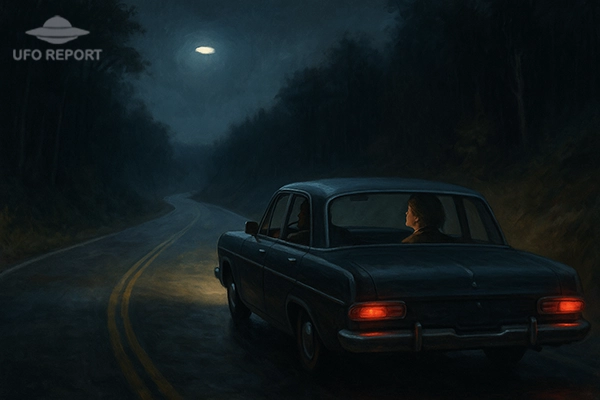
It was September 19, 1961. Betty and Barney Hill were driving south on Route 3 through the White Mountains of New Hampshire after a brief vacation in Canada. The sky was clear, the road nearly empty, and their dog, Delsey, slept quietly in the back seat.
Around 10:30 p.m., Betty noticed a bright light moving erratically in the sky. At first, she thought it might be a planet or a commercial plane. But as the object shifted positions and appeared to follow their car, her curiosity turned to concern. She urged Barney to stop the vehicle.
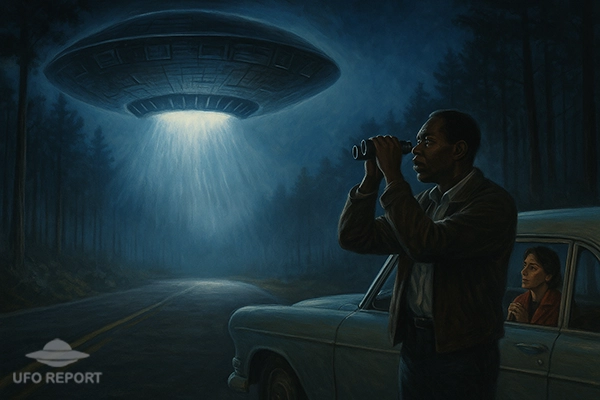
Pulling over near Indian Head, Barney took a pair of binoculars and stepped out into the cool mountain air. What he saw made his blood run cold. The light was not a star — it was a structured craft with windows. Inside, he could see what appeared to be several humanoid figures looking down at him.
As the craft descended toward them, a loud, oscillating hum filled the air. Barney felt a sudden wave of paralysis and an overwhelming sense that something was about to happen. He shouted to Betty to get back in the car. The next thing they remembered was driving down the road, confused and disoriented, with two hours unaccounted for.
The Encounter on Route 3
The couple arrived home in Portsmouth at dawn, exhausted and unsettled. Their watches had stopped working. The leather strap on Barney’s binoculars was torn. Betty’s dress was ripped and later showed strange pink powder-like stains that couldn’t be identified.
Both felt an inexplicable anxiety they couldn’t shake. Over the following days, they began to recall fragmented images — bright lights surrounding the car, figures standing in the road, and a sensation of floating. Betty began to experience vivid dreams that replayed scenes from the night, filling in the missing hours.
In her dreams, she and Barney were escorted by small gray-skinned beings into a metallic room where they were separated and examined. Betty described the beings as having large eyes, grayish-blue skin, and small mouths. They communicated not through speech but through what she called “thought transfer” — a kind of telepathic exchange.
One of the beings showed her a map of the stars, dotted with points of light connected by fine lines. When she asked where they came from, the being reportedly pointed to one star system in particular — a pair of closely aligned stars.
Fragmented Memories and Hypnosis
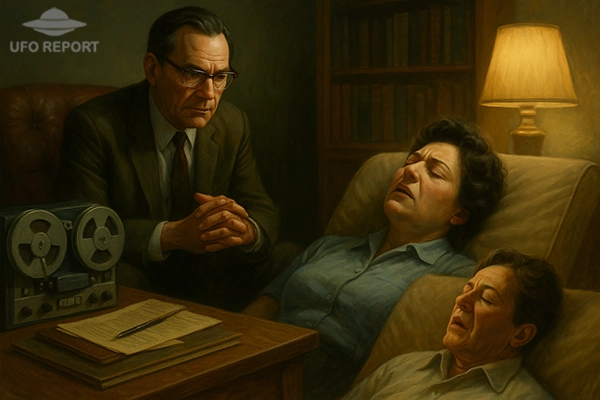
As weeks passed, the Hills’ anxiety grew. Betty’s dreams continued, each one more vivid than the last, while Barney suffered from recurring nightmares and physical stress. The couple decided to seek help, eventually finding psychiatrist Dr. Benjamin Simon, a respected Boston physician known for his work with trauma and hypnosis.
Between January and June 1964, Dr. Simon conducted a series of separate hypnosis sessions with each of them. Under deep trance, both recounted eerily similar stories.
Barney described being led onto a craft against his will. He recalled metallic walls, a circular room, and a table where he was examined. He said one of the beings placed a cup-like device on his genitals and scraped his skin with instruments. Betty described a similar examination — a needle inserted into her navel, which she said caused pain until one of the beings made her feel calm again.
Dr. Simon later interpreted their stories as a kind of “fantasy creation” that allowed the couple to process the stress of their experience. Yet even he admitted that their sincerity and emotional distress were genuine. The Hills left the sessions convinced that what they remembered had truly happened.
The Star Map and the Message
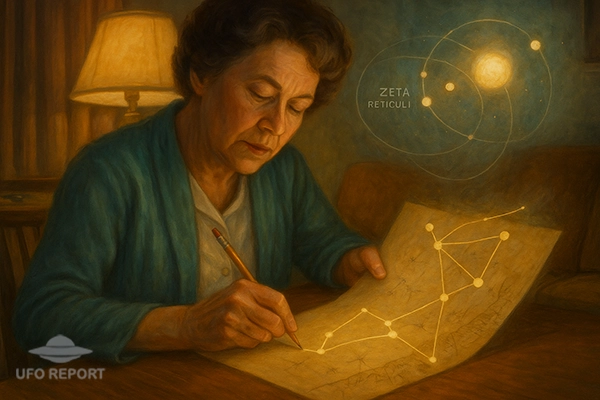
Following the hypnosis sessions, Betty recalled the star map she had been shown aboard the craft. She drew it from memory — a pattern of twelve major stars connected by lines, with one cluster emphasized as “trade routes.”
Years later, an amateur astronomer named Marjorie Fish studied the map and attempted to match it to known star systems. She proposed that it closely resembled the Zeta Reticuli binary star system, located about 39 light-years from Earth. This led to the now-famous “Zeta Reticuli Hypothesis,” which suggested that the beings Betty described were visitors from that system.
The scientific community remained divided. Some researchers found the resemblance coincidental, while others saw it as a remarkable clue that reinforced the Hills’ credibility. Betty herself remained adamant that she had drawn exactly what she saw and that the beings had shown her the map as proof of their origin.
The map, now preserved as part of UFO history, continues to fascinate both believers and skeptics for its precision and mystery.
Skepticism, Science, and Media Sensation
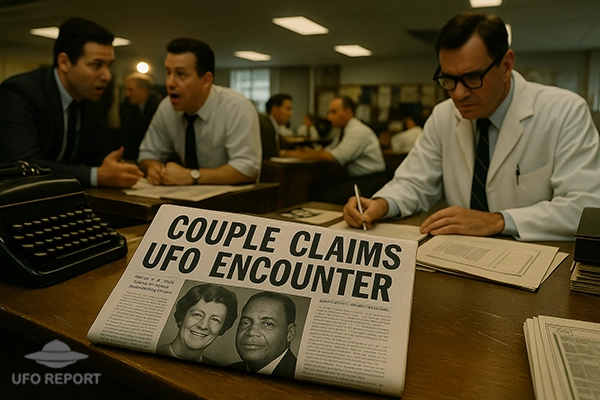
By 1965, news of the Hills’ experience had leaked to the press. The Boston Traveler published the first major article, and soon, national media descended on Portsmouth. Radio and television interviews followed, and the couple’s story was featured in Look Magazine and later adapted into a best-selling book, The Interrupted Journey by John G. Fuller.
The publicity transformed the Hills into reluctant celebrities. Barney, a postal worker and civil rights advocate, found the attention overwhelming. Betty, however, became increasingly active in UFO circles, speaking at conferences and corresponding with researchers worldwide.
Skeptics, meanwhile, sought alternative explanations. Some argued the couple’s encounter could be attributed to stress and fatigue, especially given their late-night drive and long hours. Others suggested they had seen a bright planet like Jupiter or an aircraft beacon, which their minds later filled with fantastical details under hypnosis.
Dr. Simon himself never declared the event a genuine abduction but believed the Hills’ trauma was authentic. He viewed their experiences as a form of shared psychological projection, yet even he could not explain the physical evidence — the damaged dress, the broken binocular strap, and the stopped watches.
The Hills’ Later Lives and Lasting Belief
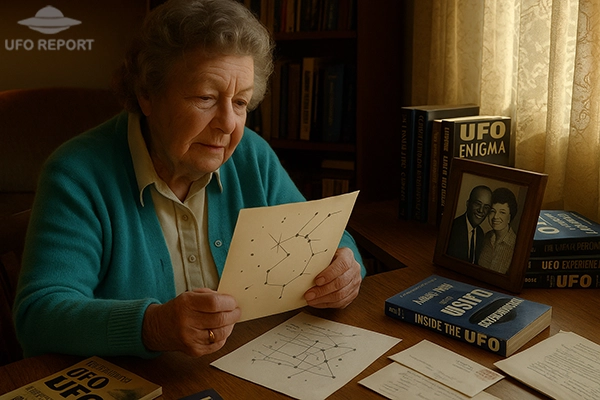
In the years following the incident, Betty and Barney Hill remained steadfast in their belief that they were taken aboard a spacecraft. Barney passed away in 1969, just eight years after the encounter, but never recanted his story. Betty continued to study UFOs well into the 1990s, collecting sighting reports and speaking publicly about her experience.
As time passed, skeptics accused Betty of exaggerating or conflating later UFO reports with her original story. Yet those who knew her personally described her as sincere, intelligent, and unshakable in her conviction.
The Hills’ experience inspired generations of researchers, filmmakers, and writers. It became the basis for the 1975 NBC television film The UFO Incident, starring James Earl Jones and Estelle Parsons. The movie portrayed their ordeal with an emphasis on psychological tension and empathy, helping humanize the couple’s fear and confusion.
Even decades later, Betty’s interviews remained consistent. “I don’t care if anyone believes me,” she once said. “I know what we experienced, and it changed my understanding of what reality can be.”
A Legacy That Changed UFO History
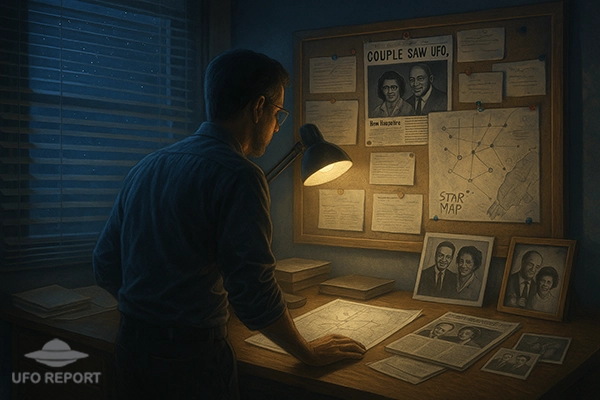
The abduction of Betty and Barney Hill is often regarded as the template for all modern alien abduction narratives. Before 1961, UFO reports mostly involved sightings of lights or objects in the sky. After the Hills, abductions with medical examinations, telepathic communication, and missing time became central to the phenomenon.
Their story also shifted UFO research from casual observation to psychological and scientific inquiry. It marked a turning point where belief in extraterrestrial visitation entered mainstream cultural dialogue.
For skeptics, the Hill case remains a study in the power of suggestion and memory. For believers, it stands as the most credible early example of contact between humans and another intelligence. But for the Hills themselves, it was deeply personal — a night that redefined their place in the universe.
Today, over six decades later, the questions raised by their experience remain unanswered. Were Betty and Barney Hill simply victims of a shared delusion, or were they chosen for a purpose we still do not understand?
Whatever the truth, their journey through fear, disbelief, and conviction continues to haunt and inspire. The light they saw over New Hampshire in 1961 has never fully faded — it still glows in the collective imagination of anyone who dares to wonder what else might be watching from the stars.