

On a crisp October night in 1967, the quiet fishing village of Shag Harbour, Nova Scotia, became the stage for one of the most credible UFO encounters ever recorded. What locals saw falling from the sky wasn’t a shooting star or a crashing plane — it was something no one, not even the Canadian military, could explain.
Just after 11 p.m. on October 4, dozens of witnesses from across the southern coast reported a glowing, orange-yellow object silently descending toward the Atlantic. “It came down without a sound,” one fisherman later recalled. “Then it just sat there, glowing under the water.”
Within hours, the Royal Canadian Mounted Police (RCMP), the Coast Guard, and local fishermen would launch a frantic rescue effort. What they found — and didn’t find — turned a simple search-and-rescue into Canada’s most enduring UFO mystery.
A Night That Changed a Village
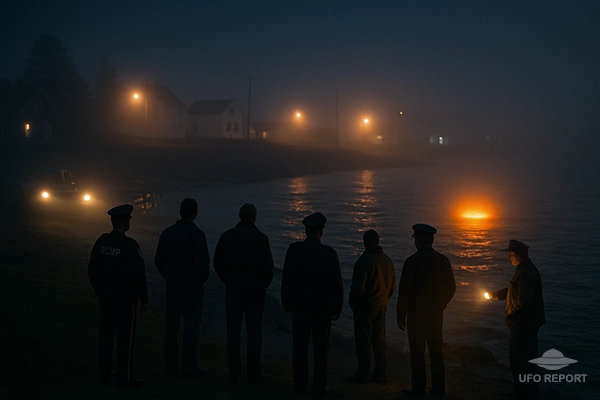
At 11:20 p.m., calls began pouring into the RCMP detachment in nearby Barrington Passage. Drivers along Highway 3 and pilots in the air all reported the same thing: a bright, disk-shaped craft about 60 feet wide, trailing sparks as it dove toward the sea. Some described a faint whistling sound before impact.
When officers arrived, they found more than a dozen residents standing along the harbor’s edge, pointing toward a pulsing yellow light beneath the waves about 300 meters offshore. One witness described it as “a dome glowing under the water, moving slowly before fading.”
Believing a commercial aircraft had crashed, RCMP Corporal Werbicki radioed for assistance, initiating a full-scale rescue. Fishing boats launched into the dark, combing the surf with floodlights. For nearly an hour, searchers followed the faint light until it disappeared entirely. No wreckage. No oil slick. No bodies.
By daybreak, every nearby airport had been contacted. Not a single aircraft was missing, and no distress calls had been logged. Whatever had gone into the sea had seemingly vanished.
The Search Beneath the Waves
The next morning, military authorities took over. The Canadian Coast Guard vessel CCGS Cape Sable and two Navy ships, HMCS Granby and HMCS Cape Scott, arrived with diving teams to scour the seabed. For two days they searched the area — running sonar, sweeping with magnetometers, and sending divers into the frigid black water.
Despite clear sonar readings of “disturbances,” they found nothing: no metal, no debris, no trace of impact. Even the seaweed and sediment looked undisturbed.
According to official reports later released through the Access to Information Act, the searchers privately admitted confusion. The object had entered the water, yet left no signature of crash or explosion. “It’s as if it entered — and then kept going,” one diver remarked years later.
Military Involvement and Cold-War Secrecy
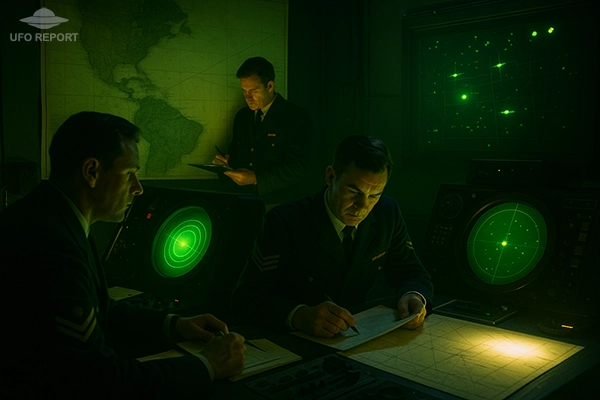
Within 48 hours, the case had reached the highest levels of the Canadian Forces and drawn interest from the United States. NORAD (North American Aerospace Defense Command) reportedly tracked unknown radar returns over the Bay of Fundy that same night, though their nature was never confirmed publicly.
Declassified documents from the Department of National Defence later revealed that the event had been officially logged as a “UFO incident.” Investigators from the Air Desk in Ottawa, the Navy’s Atlantic Command, and U.S. liaisons were all involved in correspondence over the following weeks.
Some reports — still unverified — claim sonar operators aboard U.S. submarines detected fast-moving underwater objects near the site in the days that followed. No public explanation was ever issued.
The official press line was simple: the object was likely a meteor that had entered the ocean and disintegrated. But internal memos contradicted that certainty, noting that “the matter remains unexplained.”
Theories and Speculation
As with any case that defies logic, explanations split along three major paths.
The Conventional Theory — A Meteor or Debris
Astronomers proposed the event was a bolide — a bright meteor burning low over the horizon before striking the water. Yet witnesses insisted the object moved horizontally, not downward, and maintained a steady glow underwater for nearly five minutes. No sonic boom, no shockwave, and no fragments were ever recovered.
The Military Theory — A Classified Test Vehicle
Skeptics suggest the object may have been a prototype aircraft or missile launched from a Cold-War test site and secretly retrieved. Canada and the U.S. were both experimenting with advanced submersible and anti-radar craft in the 1960s. But such a recovery in a populated fishing village would have been nearly impossible to conceal completely.
The Extraordinary Hypothesis — A Controlled Craft of Unknown Origin
For UFO researchers, the Shag Harbour object fits a pattern later echoed by the USS Omaha and other U.S. Navy “transmedium” sightings — objects capable of maneuvering both in air and underwater. Some believe the glowing light was part of a propulsion system, its descent deliberate rather than accidental.
Even the U.S. National Investigations Committee on Aerial Phenomena (NICAP) cited the case as one of the few credible “UFO splashdowns” ever documented by multiple government agencies.
Declassification and Modern Re-Evaluation
In 2001, more than 30 years after the event, declassified Canadian government files reignited interest. They revealed that authorities had formally categorized the incident as “unidentified” — not a hoax, not a known aircraft, and not a meteor.
This official ambiguity gave Shag Harbour a rare distinction: it is one of only a handful of UFO cases worldwide recognized by government agencies as both real and unexplained.
Contemporary UAP researchers now revisit the case through the lens of modern sensor data and Navy encounters. The similarities — glowing spheres, silent descent, entry into water — link a 1967 fishing village to the 21st-century era of UAP disclosure.
Legacy of the Shag Harbour Incident
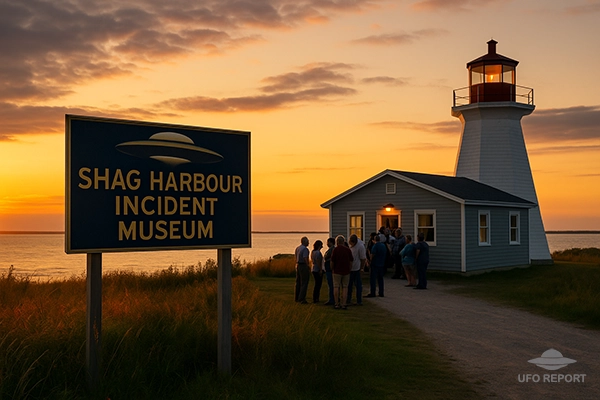
Today, the once-sleepy harbor has embraced its legacy. The Shag Harbour UFO Museum houses declassified files, news clippings, and replica models of the mysterious craft. Each October, residents hold a UFO Festival celebrating the night their small town became part of Canada’s cosmic folklore.
Visitors still gather on the pier where the light was last seen, looking out over the calm Atlantic waters. Many leave believing what locals have said for decades: something real came down that night — and it was never found.
For those who lived through it, the memory hasn’t faded.
“We saw it,” said fisherman Laurie Wickens, one of the first witnesses. “And the government saw it too. They just don’t know what it was.”
A Canadian Enigma That Endures
More than half a century later, the Shag Harbour Incident remains one of the most compelling UFO cases on record — an event backed by official reports, credible witnesses, and the complete absence of a rational conclusion.
Whether it was a meteor, a secret experiment, or something from beyond our world, the mystery continues to define the intersection of science, secrecy, and wonder.
For the people of Shag Harbour, it’s more than a story of lights in the sky.
It’s a reminder that sometimes, even when every search is exhausted and every file is stamped “unexplained,” the truth still lies somewhere beneath the waves.