

In the summer of 1951, the skies of the United States were filled with strange reports of shimmering blue-green objects that moved with a speed and precision unlike anything known at the time. From the rocky Cascades of Washington to the plains of Texas and the neighborhoods of New York City, witnesses described luminous formations gliding silently above them. Among these sightings, one event stood out and shaped the national conversation in a profound way. It took place over Lubbock, Texas, where a group of scientists and an entire community watched a pattern of blue-green lights pass repeatedly overhead in an extraordinary display that left the country searching for answers.
The Lubbock Lights remain one of the most iconic and well-documented UFO sightings in American history. They emerged during a moment when the nation was deep in Cold War tension, when anxieties about technology, the skies, and the unknown were rapidly intensifying. What unfolded in 1951 was not simply a series of sightings. It was an early national UFO wave, one that captured public imagination and influenced how America thought about the possibility of extraterrestrial visitors.
A Strange Glow Over the Cascades
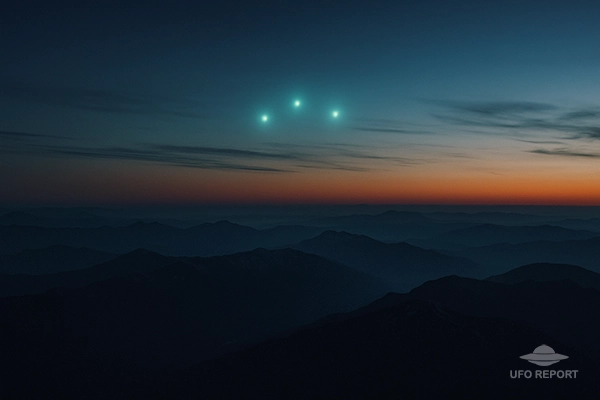
The first reports came on July 24, 1951, from the Pacific Northwest. A pilot flying over the Cascade Mountains in Washington State noticed a line of blue-green lights hovering at a distance. He described them as bright, steady, and oddly symmetrical, shifting in position as if maintaining a controlled formation. When he contacted air traffic control, he learned that no aircraft were scheduled in that region and that the lights did not correspond to any known aviation signatures.
Soon after, others began reporting similar lights across Washington, Oregon, and Idaho. Some described them as round and intensely bright, while others said the objects moved suddenly and with startling acceleration. In each account, the same qualities appeared again and again. The lights were silent. They were smooth in motion. And they glowed with a hue that was not common in aircraft lighting at the time.
These Northwestern sightings might have remained isolated curiosities if not for what happened weeks later over Texas. It was there, in Lubbock, that the phenomenon intensified and took on a more structured, almost orchestrated form.
A Hot August Night in Texas
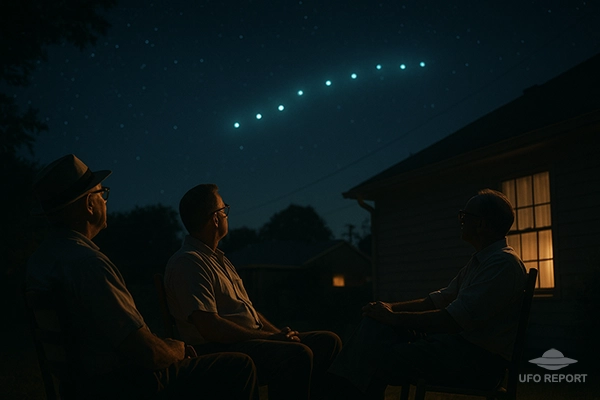
On the evening of August 25, 1951, the quiet city of Lubbock was settling in for the night when something extraordinary appeared overhead. At around 9 p.m., a V-shaped formation of glowing blue-green lights streaked across the sky in a perfect arc. The lights were luminous and uniform, as if arranged with precision. They traveled swiftly, crossing the entire sky in less than three seconds.
To make matters more remarkable, the sighting was witnessed by a group of highly respected observers: three professors from Texas Technological College. Because of their scientific backgrounds, their testimony was taken far more seriously than the typical UFO report. They described a semicircle of lights that traveled in formation and moved with a coordinated, intelligent pattern.
Moments later, another group of lights passed overhead in the same formation. Then another. And another. Over the course of that night, more than a dozen passes were witnessed across the city.
News of the sighting spread quickly, but it was the next development that cemented the Lubbock Lights as a national mystery. A young local resident managed to capture a series of photographs that seemed to show the lights in motion. The images revealed a distinct pattern of glowing objects flying in formation, their color unmistakably blue and their arrangement eerily symmetrical.
The photos became some of the most circulated UFO images of the era. Project Blue Book would later analyze them extensively but never officially debunk them, leaving the photographs as one of the most enigmatic visual records of early UFO sightings.
Patterns Across the Country
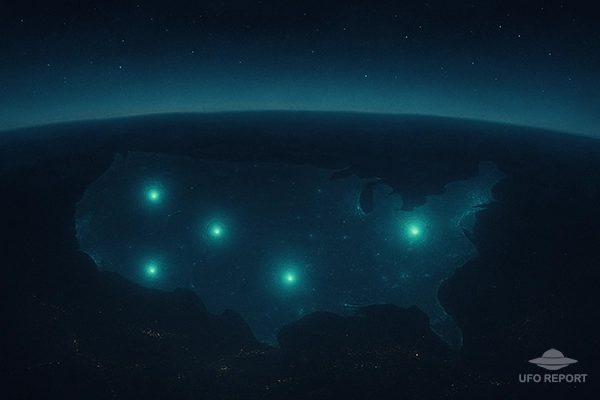
While the Lubbock Lights became the focal point, sightings did not end in Texas. Throughout late summer and early autumn, witnesses across several states reported similar blue-green objects traversing the night sky. They appeared over Arizona, Kansas, Missouri, and even parts of the East Coast.
What made the 1951 wave so compelling was its coherence. Witnesses separated by thousands of miles described nearly identical objects:
• Bright blue-green luminosity
• Silent movement
• Sudden accelerations
• Coordinated formations
• Arcing flight paths across the sky
The phenomenon was not sporadic or random. It was patterned, repeated, and observed by people with vastly different backgrounds, including pilots, teachers, farmers, students, police officers, and scientists. Even skeptical observers struggled to dismiss the consistency of the accounts.
Scientific Scrutiny and Government Interest
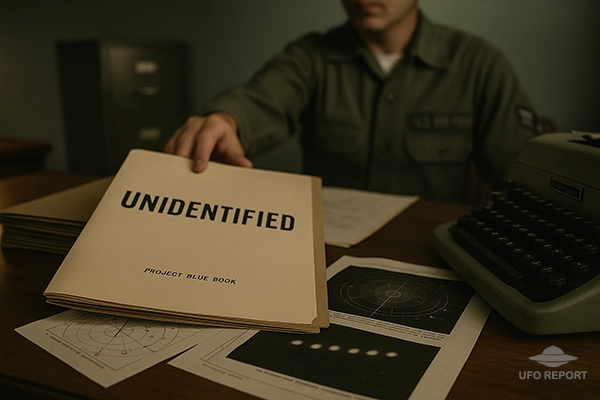
The U.S. Air Force took a keen interest in the Lubbock Lights. As reports grew, Project Blue Book sent investigators to interview the professors, inspect photographic evidence, and evaluate the possibility of misidentified natural or technological objects.
The professors remained firm in their testimony. They had seen something real, structured, and operating with a speed far beyond conventional aircraft.
Blue Book considered several explanations:
• Migrating birds reflecting city lights
• Temperature inversions causing optical distortions
• Secret military aircraft
• Astronomical or atmospheric phenomena
Each explanation failed to account for critical details. Birds could not produce uniform blue-green luminosity or move faster than a jet. Atmospheric anomalies could not maintain a repeated formation. No known aircraft of the era could travel silently at such speed with such consistency. And the sightings lasted far too long and across too many regions to be explained by isolated natural events.
One Air Force investigator later admitted that the Lubbock Lights were among the most baffling cases the program ever encountered.
The Lubbock Photographs and the Quest for Answers
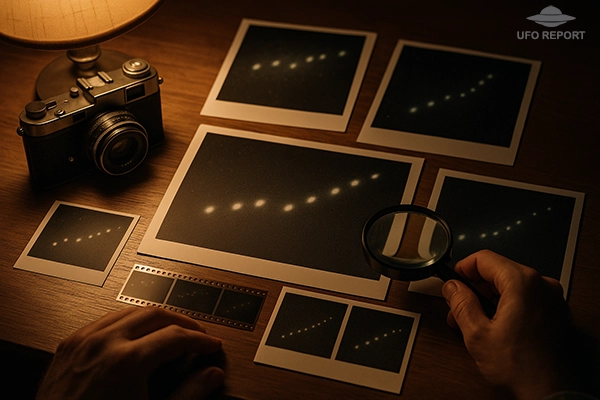
The photographs taken by the young resident, Carl Hart Jr., became central to the investigation. His images showed a distinctive crescent formation of lights in the night sky. Hart insisted that he had not doctored the photos, and no one ever proved otherwise. Even today, when analyzed with modern technology, the photos show no signs of manipulation.
The lights in the images match the descriptions provided by the professors almost perfectly. Their spacing is even. Their brightness is consistent. And their curvature suggests an object or group of objects moving in a controlled arc.
The images remain among the most important visual UFO records of the twentieth century. They represent a moment in time when photographic evidence supported mass eyewitness testimony in a way that even military analysts could not fully explain.
Theories: What Were the Lubbock Lights?
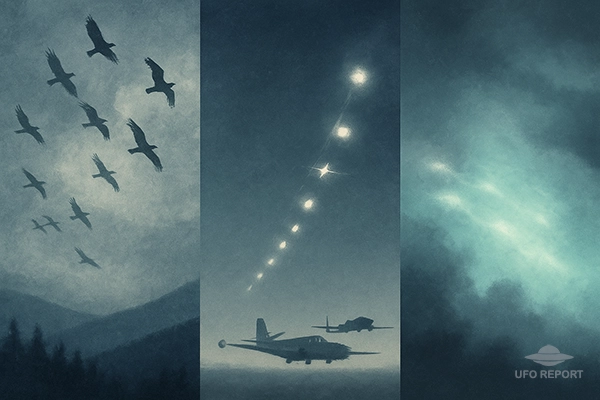
No conclusive answer has ever been found. Over the decades, several theories have circulated.
Natural Phenomenon
Some scientists argue that the lights were caused by reflections off birds, specifically plovers, whose white underbellies could theoretically reflect city lights. But this theory falters under scrutiny. The lights were blue-green, not white. They traveled far faster than birds. And the formation was too precise.
Classified Military Flights
Others propose that the lights were part of classified military tests conducted during the Cold War. Yet there is no evidence of experimental aircraft capable of such speed, silence, and luminosity in 1951.
Extraterrestrial Craft
Many researchers believe the lights represented advanced technology not of this Earth. Their speed, symmetry, and color suggest purposeful construction, and their appearance across multiple states hints at coordinated behavior.
Unknown Aerial Technology
A more neutral theory suggests that the lights were part of an unknown atmospheric or technological phenomenon that remains undiscovered.
Despite decades of speculation, none of these explanations fully account for the facts.
A Mystery That Still Haunts the Skies
The blue-green lights of 1951 left a lasting mark on American UFO history. They occurred at a pivotal moment, before the UFO discussion had fully entered mainstream culture. The Lubbock Lights in particular showed that trained observers could witness something extraordinary and remain unable to explain it, even with scientific tools and government investigation.
Today, more than seventy years later, the Lubbock Lights remain a central case for researchers studying unidentified aerial phenomena. The photographs continue to challenge skeptics. The testimonies of respected scientists keep the mystery alive. And the massive wave of sightings across the country suggests that something significant was happening in America’s skies that summer.
The question that lingered then still lingers now. What were the blue-green lights that crossed the nation and stunned the city of Lubbock? Were they natural anomalies, secret aircraft, or something far more extraordinary? Until a definitive answer emerges, the lights will remain suspended in America’s memory, glowing faintly against the dark horizon of the unknown.