

When Exercise Mainbrace began in September 1952, tensions between the West and the Soviet Union were near a boiling point. The Korean War was still in full force. Nuclear weapons had transformed global strategy. The newly formed NATO alliance was eager to demonstrate its ability to respond to a Soviet naval or aerial strike across the North Atlantic.
The scale of the operation was enormous. Ships from the United States, the United Kingdom, Norway, Denmark, the Netherlands, and Canada maneuvered across the North Sea. Dozens of airbases coordinated patrols. Radar units, coastal observers, and naval intelligence teams maintained constant watch.
The sky during Mainbrace was supposed to be filled only with NATO aircraft and the occasional civilian airliner. Yet within days of the exercise beginning, strange reports began to surface. What made the situation unique was not only the number of sightings, but also the professionalism and training of those who reported them. This was a gathering of some of the world’s most qualified pilots, radar operators, and intelligence officers. If anyone could distinguish between aircraft and something inexplicable, it was the individuals participating in Mainbrace.
The First Sightings Over Denmark
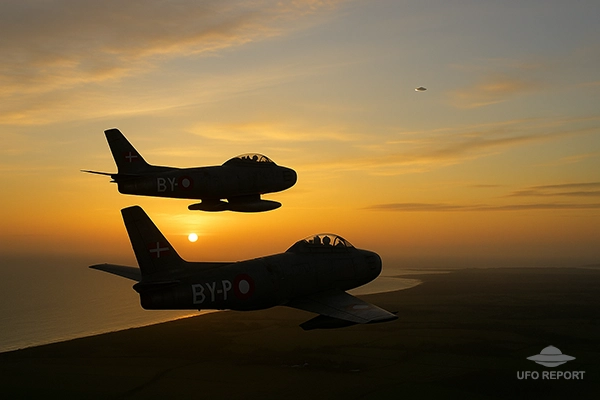
The earliest reports emerged from Danish forces near Aalborg Air Base. Pilots on patrol observed a gleaming silver disc moving against the wind at tremendous speed. Radar operators corroborated the sighting. The object had the appearance of a polished metallic disc, reflecting sunlight as it maneuvered with sharp changes in altitude. According to witnesses, the object seemed capable of hovering, accelerating instantly, and maintaining a level of control far beyond the capabilities of jets at the time.
When the pilots attempted to pursue, the object accelerated so quickly that they lost visual contact. Nothing in NATO’s arsenal, and nothing known to intelligence agencies, could match what was seen that morning.
Word spread quietly among personnel. Some assumed it was a classified American aircraft, though no such project was known to be in Europe at the time. Others dismissed the idea entirely, noting that even the most advanced experimental vehicles could not perform the movements described.
These early Danish sightings were only the beginning.
A Mysterious Object Above the USS Franklin D. Roosevelt
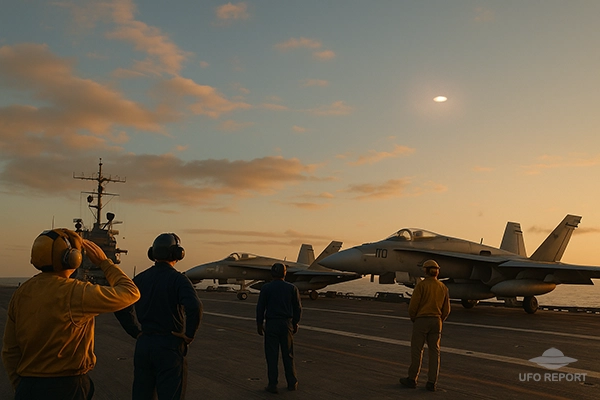
One of the most significant and widely discussed encounters occurred near the USS Franklin D. Roosevelt, an American aircraft carrier participating in Mainbrace. The Roosevelt was home to hundreds of skilled sailors, aviators, and intelligence specialists. When unusual activity appeared in the sky above the carrier, multiple witnesses were prepared to document it.
A silver, circular object reportedly hovered above the ship at a considerable altitude. It reflected sunlight with a brightness that caught the attention of deck personnel and flight crew. According to later testimony, both pilots and senior officers witnessed the event.
The object remained stationary for a period of time before accelerating upward and vanishing into the cloud layer. No aircraft aboard the Roosevelt, nor any aircraft known to the United States Navy, was capable of replicating the maneuver. Naval intelligence made discreet inquiries, and the incident was logged internally.
The presence of a UFO over an American aircraft carrier during a major NATO exercise was an embarrassment no commander wanted to publicize. The official record that eventually reached the public described the object as an “unidentified aerial phenomenon,” with no further detail offered.
Radar Operators Report the Impossible
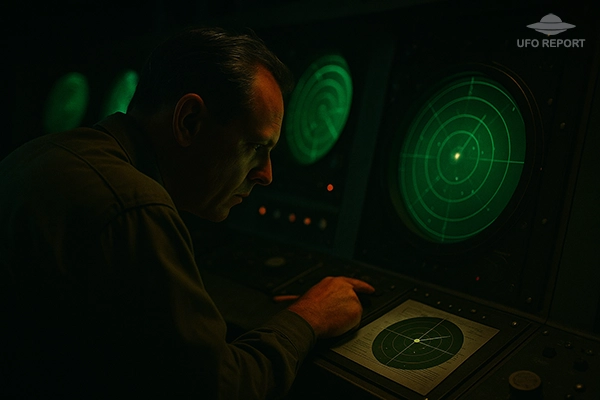
What made the Mainbrace encounters uniquely compelling was the combination of visual and radar confirmation. Across several NATO bases, operators detected objects performing instantaneous acceleration and course changes that violated the laws of inertia.
At RAF Topcliffe in the United Kingdom, airmen observed a circular, metallic object pacing a NATO aircraft before abruptly climbing vertically at a speed no jet could reach. The report was detailed, consistent, and signed by multiple witnesses. It described the object as rotating on its axis and shimmering like polished steel.
Radar technicians at nearby stations recorded brief returns that matched the timeframe of the sighting. The echoes indicated extraordinarily fast movement, followed by sudden disappearance from the scope.
Researchers later noted that these radar signatures did not resemble reflections from meteors, balloons, or known atmospheric effects. Whatever the object was, it exhibited controlled movement.
A Visit From the United States Air Force
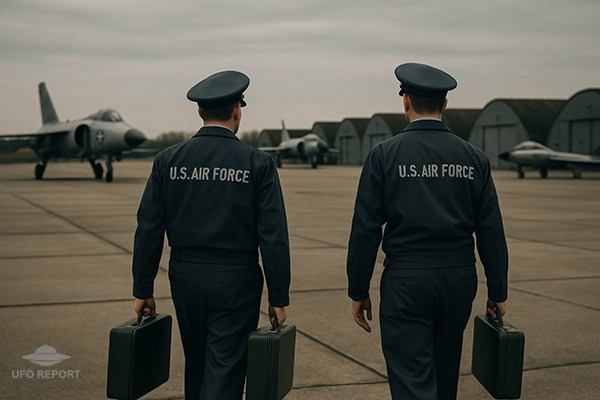
The surge of reports quickly drew attention from the United States Air Force. In 1952, the Air Force was already overwhelmed with UFO sightings across the United States during what was later called the Great UFO Wave of 1952. Washington D.C. itself had experienced highly publicized radar and visual sightings only weeks earlier.
The Air Force dispatched investigators to France, where many of the Mainbrace operations were coordinated. The team interviewed pilots, radar officers, and intelligence personnel. Their report, released to the public months later, concluded that the sightings were “likely misidentified aircraft or atmospheric phenomena.”
Privately, some investigators were not satisfied with this explanation. The witnesses were among the most capable observers in the world. Many had flown combat missions during the Second World War or conducted Cold War reconnaissance. They were not prone to misidentifying clouds or reflections.
Still, the official stance was clear: nothing unusual had occurred.
A Growing Debate in the UFO Community

When details of the Mainbrace sightings eventually reached the public, they became a point of fascination among researchers. The cases were incorporated into early UFO literature, including Edward Ruppelt’s influential work, “The Report on Unidentified Flying Objects.” Ruppelt, the former head of Project Blue Book, treated the Mainbrace sightings with a level of seriousness uncommon for the era.
Other researchers, including Richard Dolan, Lawrence Fawcett, Barry Greenwood, and Timothy Good, later examined the incidents within the broader context of Cold War secrecy. Their narratives highlighted a consistent theme: when military personnel witnessed something extraordinary, official explanations often downplayed or dismissed the events.
Mainbrace became one of the clearest examples of the gap between what witnesses reported and what governments acknowledged.
Were the Objects Soviet, Extraterrestrial, or Something Else?
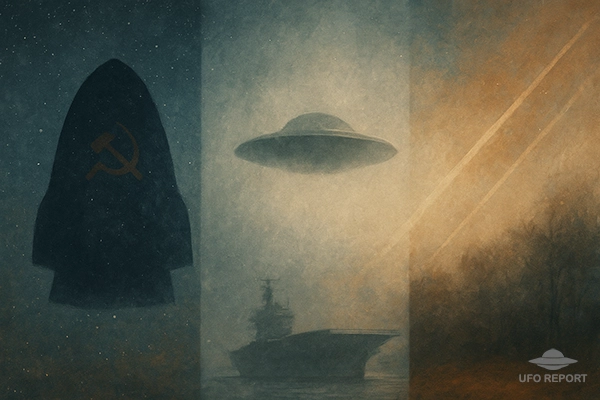
To this day, three possibilities dominate discussions of what happened during Exercise Mainbrace.
Some argue that the objects might have been advanced experimental aircraft. The Cold War was a breeding ground for innovation, and both superpowers were eager to test new technologies. However, no aircraft from the era, Soviet or Western, matched the capabilities described in the Mainbrace reports.
Others suggest extraterrestrial origin. The silver discs, the instantaneous acceleration, and the rotational movement are all features commonly associated with classic UFO encounters. The idea of non-human observation during a major military exercise is not far-fetched in UFO research circles.
A third possibility remains that these were unknown natural or atmospheric phenomena. Yet the combination of radar confirmation, simultaneous sightings across multiple nations, and consistent reports from trained observers makes this explanation difficult to sustain.
The Mainbrace objects behaved intelligently. They appeared to observe, react, and maneuver with purpose.
An Incident That Refuses to Fade

Though decades have passed, the Mainbrace UFO sightings continue to intrigue researchers. They represent one of the rare moments in history when multiple NATO nations, hundreds of trained observers, and some of the most sophisticated radar systems of the time all encountered the same unknown presence.
Mainbrace was not a cluster of civilian sightings or anecdotal accounts. It occurred in the middle of one of the most heavily monitored military operations of the Cold War. Any object in the sky that was not part of the exercise should have been cataloged and identified. Instead, the objects that appeared remain unexplained.
As interest in UFOs and UAP grows once again, the events of 1952 stand as a historical foundation for modern inquiry. They demonstrate that even the strongest military alliances can encounter the unknown. They show that the skies have long held secrets that defy conventional explanation. And they remind us that the line between national security and genuine mystery is often thinner than expected.
The Mainbrace sightings may never be fully understood, but they remain one of NATO’s most compelling encounters with the unexplained. Even after more than seventy years, the story of what happened during the 1952 war games continues to cast a long shadow over the history of military aviation and the search for answers in the skies above.